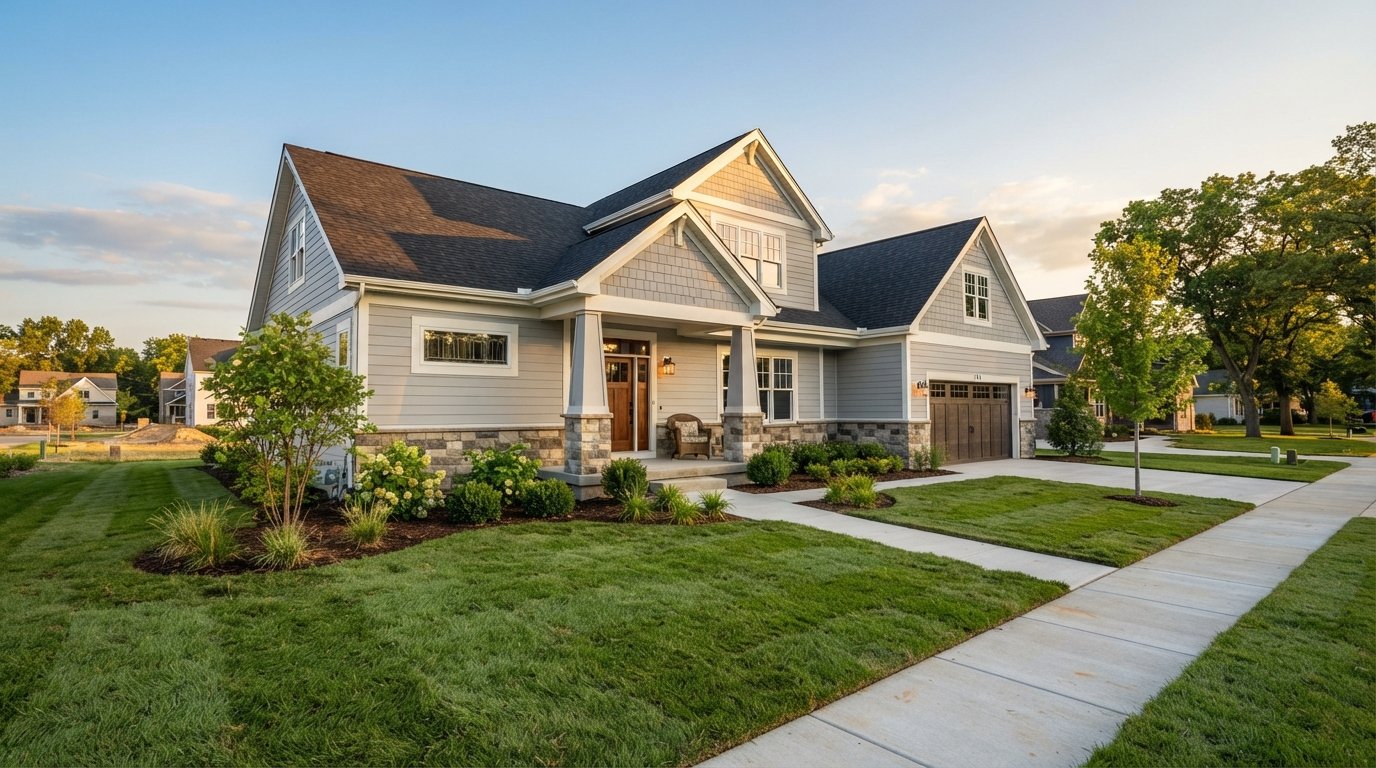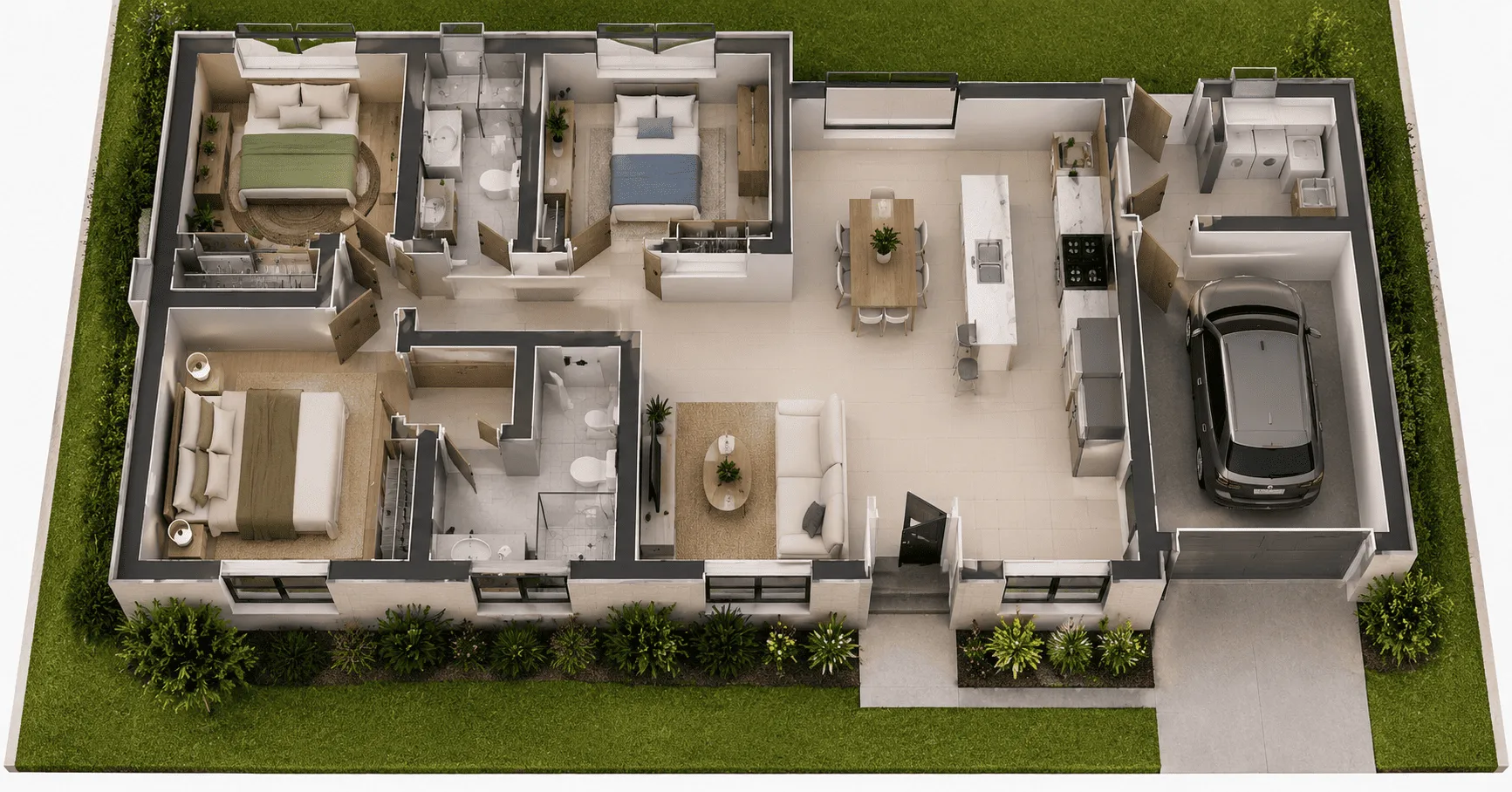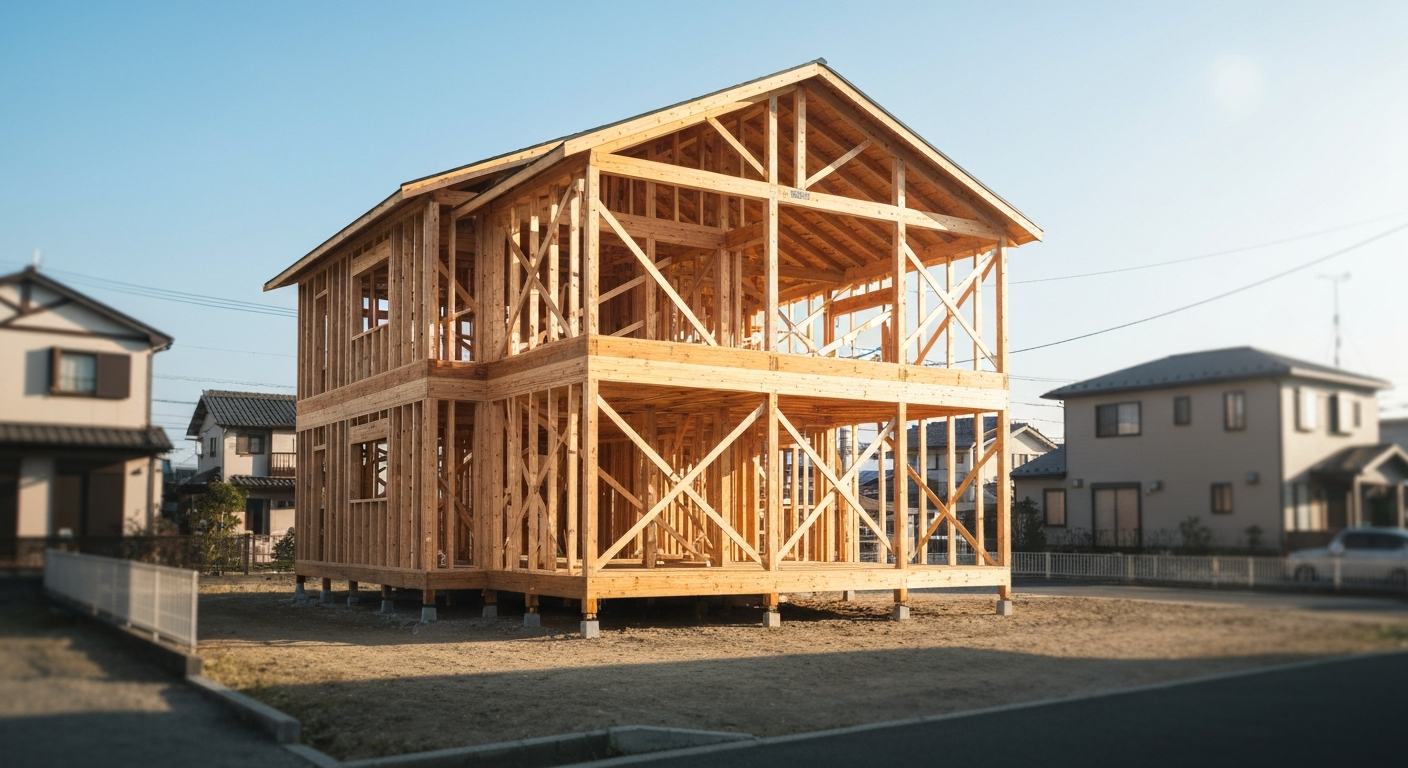
Quick answer: Building a 4 bedroom house typically costs between $280,000 and $560,000 in the United States, with most families landing around $390,000 for a home of 2,000 to 2,800 square feet. That works out to roughly $140 to $280 per square foot.
- Moving from a 3 bedroom to a 4 bedroom plan typically adds $40,000 to $90,000 to the build.
- Expect 7 to 12 months of construction plus 2 to 4 months of pre-construction for design, permits and financing.
How Much Does It Cost to Build a 4 Bedroom House? (Full Breakdown)
Building a 4 bedroom house typically costs between $280,000 and $560,000 in the United States, with most families landing around $390,000 for a home in the 2,000 to 2,800 square foot range. That works out to roughly $140 to $280 per square foot, depending on where you build, the finishes you choose, and whether you hire a general contractor or act as your own.
A four bedroom home is the most popular new-construction size in America for a reason: it fits a growing family, adds a guest room or home office, and holds resale value better than smaller floor plans. But it also crosses a threshold where costs stop scaling linearly. You are not just adding a room, you are usually adding a bathroom, more foundation, more roof, and a bigger HVAC system.
This guide breaks down every major cost, compares prices by state, bathroom count, and finish level, walks through a complete worked example from raw land to move-in, and shows you where a 4 bedroom build gets expensive so you can plan your budget with real numbers.
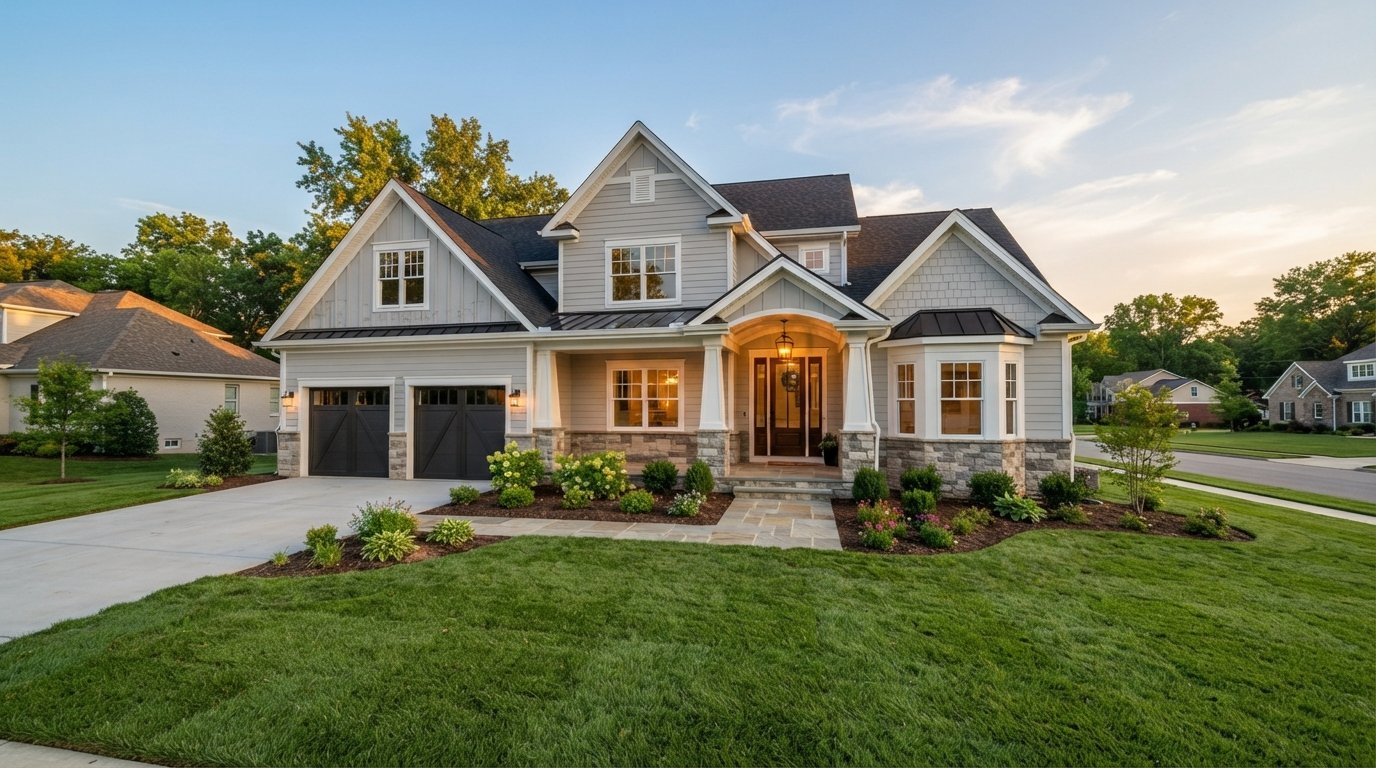
Quick Answer: Average Cost to Build a 4 Bedroom House
| Finish Level | Typical Size | Cost per Sq Ft | Total Cost |
|---|---|---|---|
| Budget / builder-grade | 1,800 to 2,200 sq ft | $140 to $170 | $250,000 to $375,000 |
| Standard | 2,000 to 2,400 sq ft | $155 to $195 | $310,000 to $470,000 |
| Mid-range | 2,200 to 2,600 sq ft | $170 to $220 | $375,000 to $570,000 |
| High-end / custom | 2,600 to 3,500+ sq ft | $220 to $400+ | $570,000 to $1.4M+ |
These figures cover construction only. Land, permits, utility hookups, and site preparation come on top, and we cover those below, because they are the numbers that most often blow up a first-time builder's budget.
What Drives the Cost of a 4 Bedroom House?
1. Square footage, not bedroom count
Builders price homes by the square foot, not by the bedroom. A compact 1,900 sq ft four bedroom can cost less than a sprawling 2,400 sq ft three bedroom. The national average for new residential construction runs $140 to $280 per square foot, and a 4 bedroom layout usually needs at least 1,800 sq ft to feel livable, with 2,200 to 2,600 sq ft being the sweet spot.
If you want the deeper math on this, see our guide to the cost to build a house per square foot.
One trap to watch when comparing quotes: not every per-square-foot number means the same thing. Industry benchmarks often cite hard construction costs only (materials and labor), which excludes the general contractor's overhead and profit margin of 15% to 25%. A "$160 per square foot" figure can become $190 to $200 once the builder's fee is included. Before comparing bids or online estimates, always confirm whether the number includes contractor markup, permits, and utility hookups, or covers hard costs alone. Two quotes that look $60,000 apart are sometimes measuring different things.
Do not over-size the plan. A common first-timer mistake is assuming four bedrooms demands 4,000+ square feet. In practice, plenty of comfortable 4 bed / 2.5 bath homes live in 1,800 to 2,000 sq ft with modest but workable bedrooms, and a well-designed 3,000 sq ft plan fits four genuinely large bedrooms with room to spare. Past that point, extra square footage is buying formal living rooms, theater rooms, and hallways, not better bedrooms. Since every additional square foot costs $140 to $280, trimming 500 sq ft of "just in case" space saves $70,000 to $140,000, often the difference between an approved loan and a declined one.
2. Bathroom count: the hidden multiplier
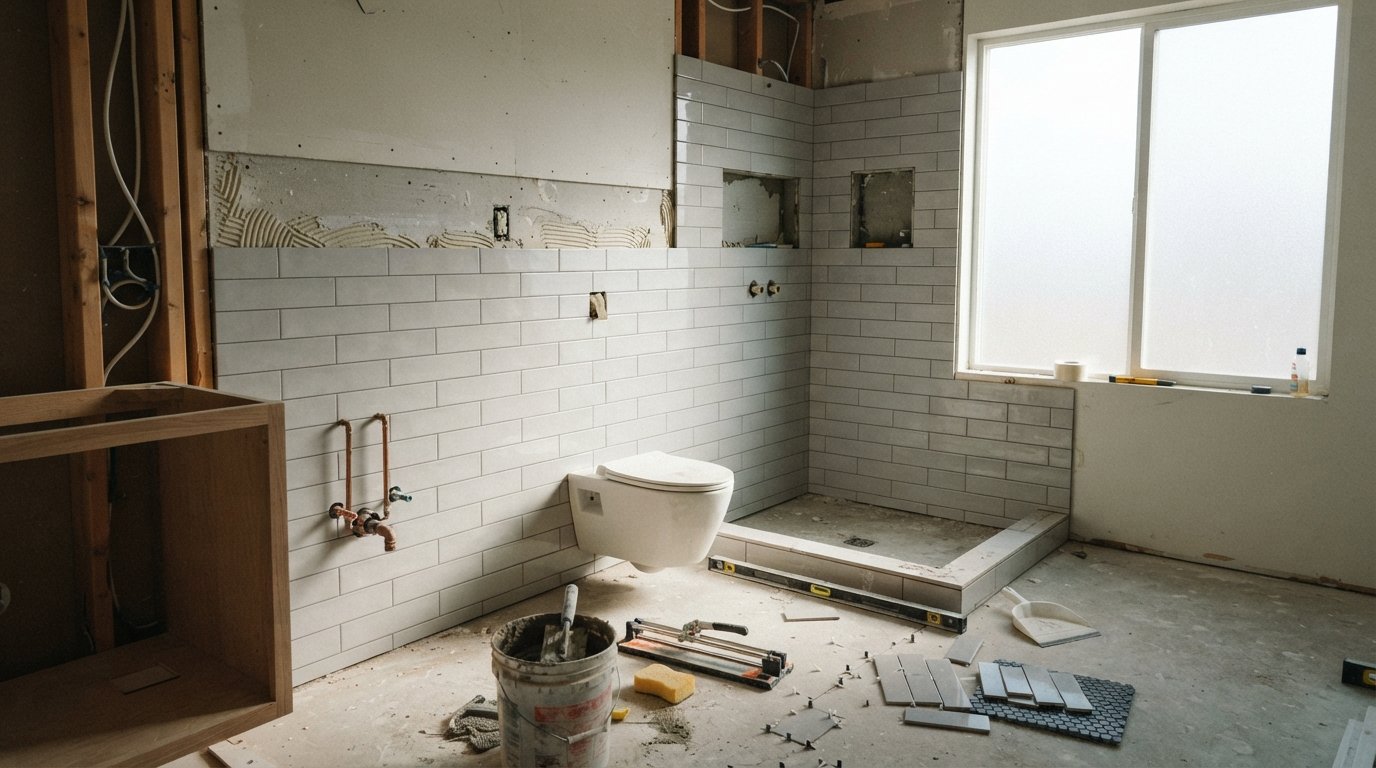
Most 4 bedroom homes come with 2.5 to 3 bathrooms, and bathrooms are the most expensive rooms per square foot in any house. Each additional full bathroom adds $25,000 to $50,000 once you count plumbing runs, fixtures, tile, waterproofing, and ventilation. For a leaner layout, see the cost to build a 3 bedroom 2 bath house.
| Configuration | Typical Total Cost | Notes |
|---|---|---|
| 4 bed / 2 bath | $260,000 to $500,000 | The budget configuration, increasingly rare in new builds |
| 4 bed / 2.5 bath | $290,000 to $530,000 | The standard family layout, best cost-to-resale ratio |
| 4 bed / 3 bath | $320,000 to $580,000 | Common above 2,400 sq ft; adds $30,000 to $50,000 over 2 bath |
| 4 bed / 3.5 to 4 bath | $360,000 to $700,000+ | Usually paired with larger custom plans |
A money-saving design rule: stack or back the bathrooms. Placing bathrooms above each other on a two-story plan, or back-to-back on one floor, shortens plumbing runs and can save several thousand dollars per bathroom without changing how the house lives.
3. One story vs. two stories
A two-story 4 bedroom is usually 10% to 15% cheaper than a single-story ranch of the same square footage. The reason is simple: half the foundation, half the roof, which are two of the most expensive components of the entire build. In expensive-land markets, going vertical also lets you build on a smaller and cheaper lot.
The counterpoints: two-story homes need stairs (which consume 80 to 120 sq ft of floor area), cost slightly more to heat and cool evenly, and single-story living commands a premium at resale in retiree-heavy markets like Florida and Arizona. If your market skews toward older buyers, the ranch premium can pay for itself when you sell.
4. Design complexity
Simple shapes are cheap to build. Every corner, angle, dormer, and roof valley adds framing labor, flashing, and potential leak points. A rectangular footprint with a straightforward gable or hip roof can cost $15,000 to $40,000 less than the same square footage arranged in a complex shape with multiple rooflines. Keeping the house depth within standard truss spans also avoids custom-engineered roof framing, one of those invisible line items that quietly inflates bids.
5. Location
Labor and material costs swing dramatically by state. The same 2,400 sq ft, 4 bedroom home can cost $330,000 in North Carolina and over $600,000 in coastal California. Building codes matter too: hurricane zones require impact-rated windows and stronger connections, cold climates require deeper foundations, and seismic areas add engineering costs.
Cost to Build a 4 Bedroom House by State
| State | Cost per Sq Ft | 4 Bedroom (2,400 sq ft) Estimate |
|---|---|---|
| Mississippi | $125 to $165 | $300,000 to $395,000 |
| Tennessee | $130 to $170 | $310,000 to $410,000 |
| Ohio | $130 to $175 | $310,000 to $420,000 |
| Michigan | $130 to $175 | $310,000 to $420,000 |
| Texas | $130 to $180 | $310,000 to $430,000 |
| North Carolina | $135 to $185 | $325,000 to $445,000 |
| Georgia | $135 to $190 | $325,000 to $455,000 |
| Florida | $140 to $200 | $335,000 to $480,000 |
| Pennsylvania | $145 to $205 | $350,000 to $490,000 |
| Arizona | $145 to $210 | $350,000 to $505,000 |
| Illinois | $150 to $220 | $360,000 to $530,000 |
| Colorado | $160 to $240 | $385,000 to $575,000 |
| Washington | $170 to $260 | $410,000 to $625,000 |
| New York | $180 to $300 | $430,000 to $720,000 |
| Massachusetts | $200 to $320 | $480,000 to $770,000 |
| California | $200 to $400 | $480,000 to $960,000 |
| Hawaii | $210 to $400+ | $505,000 to $960,000+ |
Regionally, the pattern is consistent: the Midwest and South build cheapest, the coasts cost the most, and within any state, a rural county is typically 10% to 20% cheaper than a metro area, mainly due to labor rates, land, and permit costs. For state-specific deep dives, see our guides on building in California, North Carolina, and our state-by-state cost guide. For state-level detail, see the cost guides for Texas, Tennessee and Florida.
Full Cost Breakdown for a 4 Bedroom Build
Here is where the money actually goes on a typical $390,000 mid-range build:
| Category | Share of Budget | Typical Cost |
|---|---|---|
| Framing and structure | 15 to 18% | $58,000 to $70,000 |
| Interior finishes (flooring, cabinets, paint, trim, drywall) | 24 to 28% | $94,000 to $109,000 |
| Major systems (HVAC, plumbing, electrical) | 14 to 17% | $55,000 to $66,000 |
| Foundation | 10 to 12% | $39,000 to $47,000 |
| Roofing and exterior (siding, windows, doors) | 13 to 15% | $51,000 to $59,000 |
| Kitchen and bathrooms (fixtures, counters, appliances) | 10 to 14% | $39,000 to $55,000 |
| Site work and landscaping | 5 to 7% | $20,000 to $27,000 |
| Permits, fees, and inspections | 2 to 4% | $8,000 to $16,000 |
Two useful rules of thumb hide inside this table. First, materials and labor split roughly 50/50 to 60/40 on most residential builds, so when material prices spike (lumber, concrete, copper), your total moves fast. Second, the "boring" categories you never see in photos (foundation, framing, systems) consume about half the budget. This is exactly where you should never cut corners, because fixing structural or mechanical shortcuts later costs multiples of doing it right the first time.
How much does the builder make?
General contractors add 15% to 25% on top of hard costs for overhead and profit. On a $390,000 build, that is roughly $50,000 to $80,000. It is not pure profit: the margin covers project management, scheduling, insurance, warranty service, and the builder's business costs. Builders with strong reputations in hot markets charge the top of the range.
When evaluating bids, ask for an itemized breakdown that separates materials, subcontractor labor, and the builder's own fee. An itemized bid lets you compare apples to apples, negotiate specific lines, and spot the difference between a genuinely cheaper bid and one that simply left things out.
Costs that are NOT in the construction price
These catch almost every first-time builder off guard:
- Land: $50,000 to $300,000+ depending on region and lot size. As a rough guide: rural lots often run $8,000 to $15,000 per acre, established suburban residential lots $30,000 to $100,000+, and premium urban or coastal lots $200,000 and up
- Site preparation: clearing, grading, and excavation run $5,000 to $40,000; a sloped, rocky, or wooded lot sits at the high end
- Soil testing and surveys: $1,000 to $5,000, and worth every dollar, because bad soil discovered after the foundation pour is a five-figure problem
- Utility hookups: $10,000 to $30,000 for water, sewer (or septic), gas, and electric if the lot is not already served; rural lots without infrastructure can exceed this
- Well and septic: $15,000 to $40,000 combined on rural lots
- Impact fees: some fast-growing counties charge $5,000 to $25,000 per new home
- Construction loan interest carry: during the build you pay interest-only on the amounts drawn, and construction loan rates run 1 to 2 points above a standard mortgage. Over a 10 to 12 month build on a $400,000 project, that quietly adds $10,000 to $30,000
- Temporary housing: if you sell your current home before the new one is done, 6 to 12 months of rent can add $10,000 to $35,000
- Landscaping and driveway: $5,000 to $20,000 for grading, sod, basic plantings, and a paved drive
- Change orders: every mid-construction change (moving a wall, upgrading a finish) typically adds 10% to 15% to the affected line item. Locking your specifications before ground-breaking is the cheapest decision you will ever make
- Contingency: experienced builders recommend holding 10% to 15% of the construction budget in reserve for surprises
A realistic all-in plan adds 15% to 20% on top of the quoted construction price to absorb this list.
Worked Example: From Raw Land to Move-In
To make the numbers concrete, here is a complete budget for a 2,400 sq ft, 4 bed / 2.5 bath, two-story home at standard finishes in a mid-cost suburb (think Raleigh, San Antonio, or Columbus):
| Item | Cost |
|---|---|
| Construction at $175/sq ft (incl. builder margin) | $420,000 |
| Suburban lot | $75,000 |
| Site prep and grading | $12,000 |
| Utility hookups | $15,000 |
| Permits, fees, and surveys | $9,000 |
| Landscaping and driveway | $10,000 |
| Construction loan interest carry (11 months) | $18,000 |
| Contingency (10% of construction) | $42,000 |
| All-in total | $601,000 |
The same house in a low-cost rural county, with a $25,000 lot, cheaper labor at $150/sq ft, and a well/septic setup, lands closer to $470,000 all-in. In a coastal California metro, the identical floor plan can pass $900,000 once land enters the picture. This is why "how much does a 4 bedroom house cost" has no single answer, and why the per-square-foot method plus a local land price gets you to a realistic number faster than any national average.
Production Builder vs. Custom Build
The single biggest strategic decision, before finishes, before floor plans, is who builds your house:
Production builder. You pick one of a handful of proven 4 bedroom floor plans in a planned community or on your lot. It is the cheapest and fastest route: expect 20% to 30% less per square foot than custom, a predictable contract price, and a build time of roughly 7 to 9 months. Production builders also frequently offer incentives (rate buydowns, free upgrade packages) that further close the gap versus buying an existing home. The trade-off is limited design freedom: you choose from option packages rather than designing rooms.
Custom build. Full control over lot orientation, layout, ceiling heights, and every finish, at a premium of 20% to 30% per square foot, plus architect fees of 8% to 15% of construction cost, and a timeline of 12 to 18 months. Custom also carries more budget risk: change orders during construction typically add 10% to 15% to each line item they touch, and bespoke materials mean longer lead times.
Modified stock plan (the middle path). For most families building their first 4 bedroom home, buying a stock plan for $1,000 to $4,000 and paying for a few targeted modifications captures most of the customization that matters at a fraction of the custom price. You get the kitchen island you want without paying an architect to reinvent the staircase.
Modular and prefab. Factory-built homes assembled on site start around $100 to $150 per square foot before land and site work, and modern modular quality is far beyond the old stereotypes. For a budget-focused 4 bedroom on land you already own, modular is worth a serious quote, especially in rural areas where local contractor availability is thin.
Building in Phases: Grow the House With Your Budget
If the full 4 bedroom budget is out of reach today, you do not have to abandon the plan; you have to sequence it. In the U.S., the practical version of "building in stages" is building the structure for the final house now and finishing spaces later, because construction loans require a completed, habitable home at closeout:
- Unfinished basement, framed for bedrooms. Building a full basement with egress windows, rough plumbing, and proper ceiling height costs a fraction of finished space. Finishing it later into a 4th bedroom and bath typically runs $30,000 to $60,000, far less than building that space from scratch
- Bonus room over the garage. Framing the space and roughing in electrical during the build, then drywalling and finishing it in a few years, is a classic path from 3 finished bedrooms to 4
- Attic trusses instead of standard trusses. For a modest premium at framing time, attic trusses create a future room-sized space upstairs that standard webbed trusses make impossible to convert
- Stub out, do not build out. Roughing in plumbing for a future bathroom costs $2,000 to $5,000 during construction; adding those same pipes to a finished house costs several times that
The rule that makes phasing work: spend fully on everything structural and behind the walls, defer only what is cosmetic or finishable later. Foundations, framing, roofing, and rough mechanicals must be done right and done once. Paint, flooring in a bonus room, and the basement bar can wait for next year's budget without compromising the house.
4 Bedroom vs. 3 Bedroom: Is the Extra Room Worth It?
Moving from a 3 bedroom to a 4 bedroom plan typically adds $40,000 to $90,000 to the build: roughly 250 to 400 extra square feet, plus the half bath that usually comes with it.
From a resale standpoint, the fourth bedroom is one of the best investments in new construction. Four bedroom homes attract the widest buyer pool (families, remote workers who need an office, multigenerational households) and in most suburban markets they appreciate faster than 3 bedroom homes of similar quality. The fourth bedroom also future-proofs the house: it flexes between nursery, office, gym, and guest room as your life changes, which is exactly why it holds value.
If you are still deciding on size, compare the numbers in our guides to the cost to build a 3 bedroom house, a 2 bedroom house, and a 1 bedroom house.
Is It Cheaper to Build or Buy a 4 Bedroom House?
In most metro areas with healthy existing inventory, buying is cheaper than building, typically by 10% to 20% once you include land, permits, and hookups in the build price. The median existing home in the U.S. sells for around $400,000, while a comparable new 4 bedroom build runs $470,000 to $600,000 all-in in mid-cost markets.
Building wins when:
- Land is cheap: rural or exurban lots under $30,000 flip the math
- Local inventory is thin, old, or overpriced for what you get
- You already own the lot
- Builder incentives (rate buydowns, included upgrades) close the price gap
- You need something resale stock rarely offers: full accessibility, top-tier energy efficiency, or a very specific layout
- You plan to stay 10+ years, long enough for the new-build premium to amortize
Buying wins when:
- You need to move within 90 days; no build timeline fits
- Your market has deep inventory and competitive pricing
- Your cash reserves are tight: builds demand bigger down payments plus the ability to absorb change orders and interest carry
- You value established neighborhoods, mature trees, and proven school zones
How Long Does It Take to Build a 4 Bedroom House?
Expect 7 to 12 months of construction for a mid-range 4 bedroom home, plus 2 to 4 months of pre-construction (design, permits, financing). The full sequence:
- Planning and design: 2 to 4 months
- Permitting: 1 to 3 months, longer in strict-zoning or environmental-review jurisdictions
- Site prep and foundation: 3 to 6 weeks
- Construction: 6 to 10 months for production plans, 10 to 15 for custom
- Final inspections and closeout: 2 to 4 weeks
Timeline varies more by location than by house size. Permit turnaround alone ranges from two weeks in parts of Texas to several months in California coastal counties. Weather, material lead times, and subcontractor scheduling stretch things further, and every delay costs real money in loan interest and temporary housing. We have detailed timelines for Florida, Georgia, and Texas.
How to Finance a 4 Bedroom Build
Most people cannot pay $400,000+ in cash, and a standard mortgage does not cover a house that does not exist yet. The main routes:
Construction-to-permanent loan. One closing, one set of fees. The lender releases money in draws as construction milestones are hit (foundation, framing, dry-in, finishes), and the loan converts to a regular mortgage when the house is done. Expect to need a 20% down payment and a signed builder contract; some government-backed one-time-close programs allow as little as 5% down for qualified borrowers.
Standalone construction loan. Short-term (usually 12 months), interest-only during the build, then you refinance into a mortgage. More flexible, and you can shop mortgage rates at completion, but two closings mean two sets of fees, and you carry interest-rate risk during construction.
Land loan. If you buy the lot separately before building, land loans carry shorter terms (5 to 15 years), higher rates, and down payments of 20% to 50%. Many builders roll the lot into the construction loan instead when possible.
During the build phase you pay interest-only on drawn amounts at a rate typically 1 to 2 points above a 30-year fixed mortgage. That is why every month of delay has a visible price tag, and why a larger down payment directly reduces your monthly carry.
If you already own a home with equity, a home equity loan can also fund part or all of the build. We compare the trade-offs in home equity loan vs. construction loan, and you can model your payments with our construction loan calculator.
10 Ways to Lower the Cost of a 4 Bedroom Build
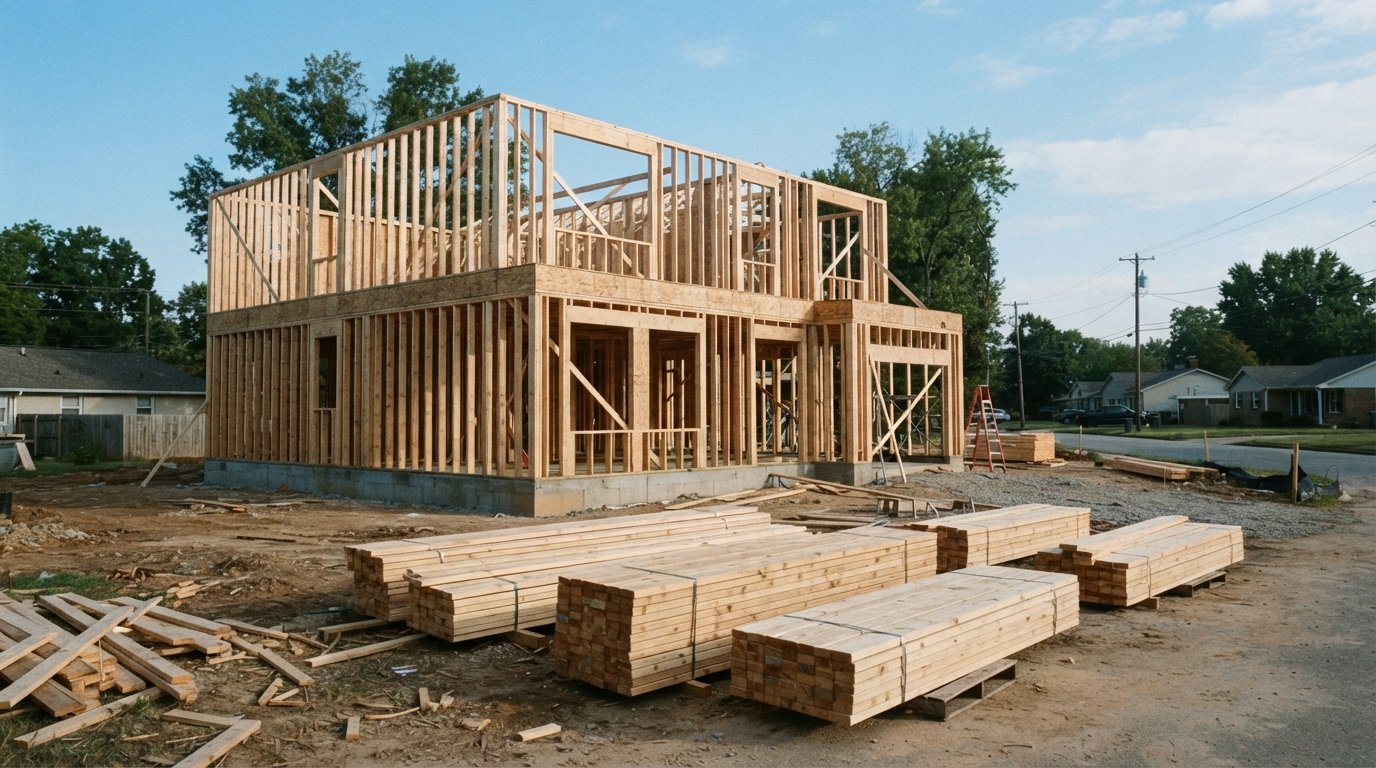
- Build two stories. Same square footage, smaller foundation and roof, savings of 10 to 15%.
- Choose a simple roofline and rectangular footprint. Every corner, dormer, and roof valley adds labor. A clean shape can save $15,000 to $40,000, and keeping the house within standard truss spans avoids custom-engineered framing.
- Use a stock floor plan instead of a custom design. Architect fees for full custom design run 8 to 15% of construction cost; a modified stock plan costs $1,000 to $4,000.
- Stack the plumbing. Placing bathrooms above the kitchen or above each other shortens plumbing runs and saves thousands. More ways to cut the total are in our guide on how to save money on building a house.
- Go builder-grade now, upgrade later. Countertops, light fixtures, and flooring are easy to replace in five years. Foundations, framing, and windows are not. Standard-sized windows and doors, prefab cabinets, and vinyl siding keep the base price honest.
- Get at least three itemized contractor bids. Bids on identical plans routinely vary by 15 to 20%, and itemized bids let you negotiate line by line, verify insurance, and check references properly.
- Lock material prices in the contract. A fixed-price contract shifts the risk of lumber and steel price swings to the builder instead of you.
- Pick the lot with your head, not your heart. Moving 15 to 20 minutes further from the metro center can halve the land price, and a flat, cleared, utility-served lot saves $20,000+ in site work versus a scenic sloped one.
- Time your build. Signing a contract in late fall, when builders are filling their winter schedule, can earn meaningful discounts in many markets.
- Freeze your selections before ground-breaking. Change orders add 10 to 15% to every line they touch. Decide the faucets, the flooring, and the paint colors before the foundation pour, not after.
Want a personalized number? Run your specs through our construction cost calculator.
Mistakes That Blow Up 4 Bedroom Budgets
- Budgeting the construction quote as the total. The all-in number is 15% to 20% higher once land-adjacent and financing costs land. Plan for it from day one
- Skipping soil tests and surveys to save $2,000. Expansive clay, high water tables, or ledge rock discovered mid-excavation are five-figure surprises
- Building unpermitted or under-permitted. Fines, forced rework, insurance denials, and blocked future sales all cost more than any permit fee
- Cutting the foundation or structure to fund finishes. Granite can wait; footings cannot be redone
- Over-building for the neighborhood. Your resale value is anchored by surrounding homes. A $700,000 house on a street of $400,000 homes will not appraise at its cost
- Choosing the cheapest bid without checking it. Verify license, insurance, references, and what the bid excludes. The cheapest number is often the least complete one
- Making decisions under time pressure. Every rushed selection is a candidate for an expensive change order later
Frequently Asked Questions
Is it cheaper to buy or build a 4 bedroom house? In most U.S. markets, buying an existing 4 bedroom home is 10% to 20% cheaper than building the same house new, once you include land. Building wins when you plan to stay 10+ years, when local inventory is old or overpriced, when you already own the land, or when builder incentives close the gap.
How much does it cost to build a 4 bedroom, 3 bath house? Plan on $400,000 to $600,000 for a mid-range 4 bed / 3 bath home of 2,400 to 2,800 sq ft. The third full bathroom adds roughly $30,000 to $50,000 over a comparable 2 bath plan.
How much does it cost to build a 4 bedroom, 2 bath house? A 4 bed / 2 bath configuration is the budget end of the range: roughly $260,000 to $500,000 depending on size, state, and finishes. It is increasingly rare in new construction because a half bath adds relatively little cost and a lot of daily convenience and resale appeal.
Can I build a 4 bedroom house for $250,000? Yes, in low-cost states (Texas, parts of the Southeast and Midwest), with a compact plan around 1,800 sq ft, builder-grade finishes, a simple two-story design, and land you already own or buy cheaply. Modular construction widens the possibilities further. In high-cost coastal states, $250,000 will not cover construction alone.
How much down payment do I need to build a 4 bedroom house? Typically 20% to 25% for a conventional construction loan, so $80,000 to $120,000 on a $400,000 to $480,000 all-in project. Some government-backed one-time-close programs allow as little as 5% down for qualified borrowers, though rates and fees differ.
How big is a typical 4 bedroom house? Most 4 bedroom homes fall between 1,800 and 2,800 square feet. Below 1,800 sq ft, bedrooms start to feel cramped; above 2,800 sq ft, you are usually paying for formal rooms and larger common areas rather than the bedrooms themselves. A well-designed 3,000 sq ft plan already fits four large bedrooms comfortably.
Does a 4 bedroom house cost more per square foot than a smaller home? Usually slightly less. Fixed costs like the kitchen, HVAC equipment, and permit fees spread across more square footage, so cost per square foot tends to fall as homes get bigger, even though the total price rises.
How long does it take to build a 4 bedroom house? Production-plan homes take 7 to 9 months of construction; custom homes take 12 to 18 months. Add 2 to 4 months up front for design, permits, and financing before ground-breaking.
Can I build a 4 bedroom house in stages? Not in the paused-and-resumed sense common in some countries: U.S. construction loans require a completed, habitable home. The American version of phased building is structural: build the full shell now with an unfinished basement, bonus room, or attic-truss space roughed in for plumbing and electrical, then finish those rooms in later years for a fraction of new-construction cost.
Is building a 4 bedroom house a good investment? Generally yes, if you hold it. Four bedroom homes attract the widest buyer pool and appreciate well in family-oriented suburbs. The caveat: new builds carry a premium over existing stock, so the investment case strengthens the longer you stay and the cheaper your land was.
The Bottom Line
A 4 bedroom house costs $280,000 to $560,000 to build for most American families, with $390,000 as a realistic mid-range construction target and roughly $470,000 to $600,000 all-in once land, site work, financing, and contingency enter the picture in a mid-cost market. Your two biggest levers are location and finish level; your two most common budget killers are site work and change orders during construction.
Start with a realistic per-square-foot number for your state, confirm whether quotes include the builder's 15% to 25% margin, price your land and site prep before falling in love with a floor plan, and hold 10% to 15% in contingency. Do that, and a 4 bedroom build is one of the most financially sound homes you can put your money into.