You own a home, or you are about to build one, and the project in front of you costs more than what is sitting in your savings account. Maybe it is a kitchen that has not been touched since the previous owner. Maybe it is an addition for a growing family. Maybe it is a piece of land and a set of blueprints. Whatever the project, you have probably typed some version of this question into a search bar: should I use a home equity loan or a construction loan?
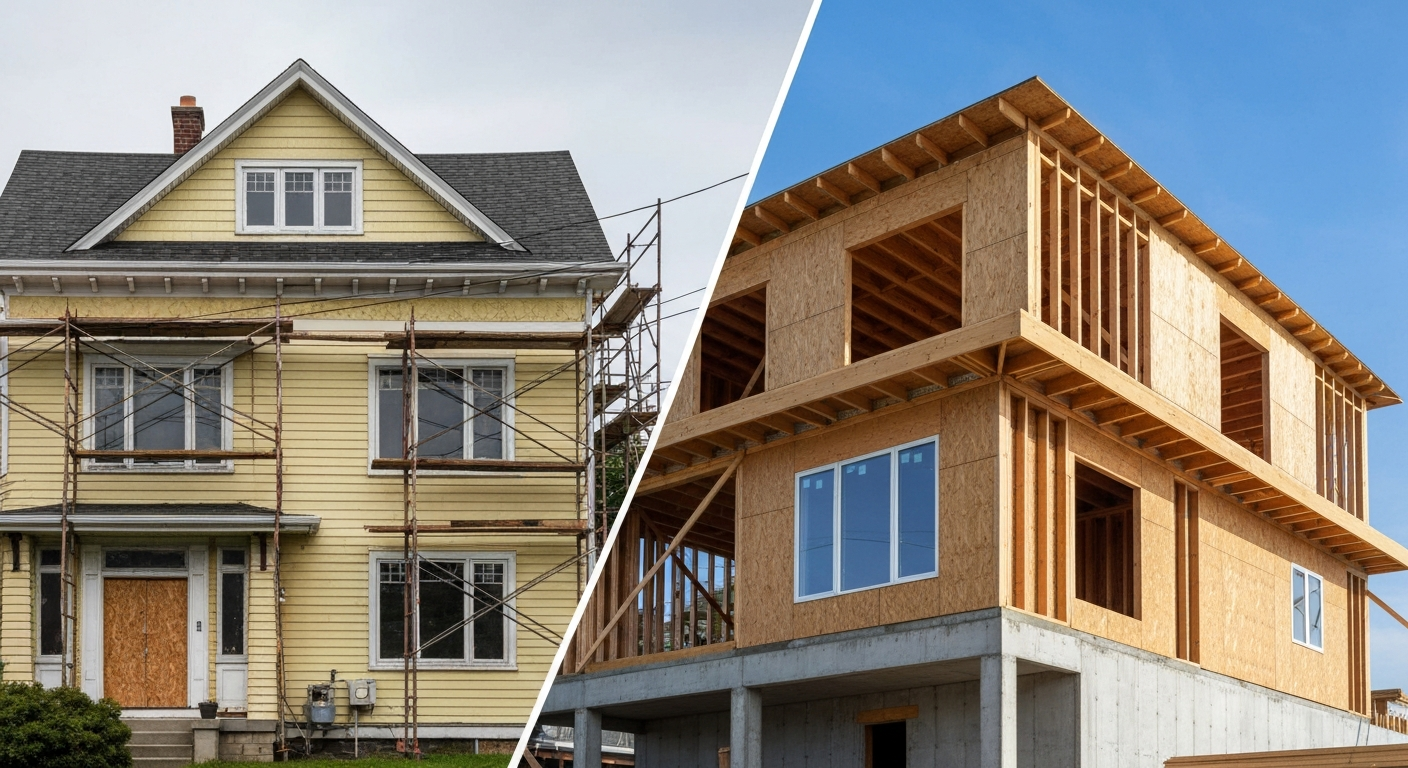
Here is the short answer, and then we will earn it: a home equity loan is usually the better fit for renovating or expanding a home you already own, because it borrows against value that already exists. A construction loan is usually the better fit for building a new home from the ground up, because it lends against the future value of something that does not exist yet. The right choice for you depends on three things: how much equity you have today, what exactly you are building, and how you want payments to work while the project is underway.
That short answer hides a lot of nuance, though, and the nuance is where borrowers get burned. So let's walk through both loans the way a good loan officer would explain them to you across a desk: how they work, what the lender is really evaluating, where each one shines, and where each one quietly becomes expensive.
Quick answer: Use a home equity loan to renovate or expand a home you already own, and a construction loan to build a new home from the ground up.
- Home equity loan: usually the better fit for renovations and additions, because it borrows against value that already exists
- Construction loan: usually the better fit for a new build, because it lends against the future value of a home that does not exist yet
- Your choice comes down to three things: how much equity you have today, what exactly you are building, and how you want payments to work during the project
How a home equity loan actually works
Think of a home equity loan as unlocking money you have already earned but cannot spend. Every mortgage payment you have made, and every dollar your home has appreciated, has been quietly building equity: the gap between what your home is worth and what you still owe on it.
A home equity loan lets you convert part of that gap into cash. You receive the full amount as a single lump sum, and you repay it in fixed monthly installments over a set term, typically with a fixed interest rate. It is sometimes called a second mortgage, because that is functionally what it is: a second loan sitting behind your original mortgage, secured by the same house.
From the lender's chair, this is a comfortable loan to make. The collateral exists. It has an address. An appraiser can walk through it on Tuesday and produce a value by Friday. So the approval process is comparatively straightforward:
- An appraisal of your current home
- A review of your credit history and score
- Verification of income and existing debts
- A calculation of how much equity you can safely borrow against, since lenders will not let you drain it to zero
The whole process usually feels familiar to anyone who has closed a mortgage before, just lighter.
The catch is structural, and it is right there in the name. Your borrowing power is capped by the equity you have today. If you bought your home two years ago with a small down payment, or if your local market has been flat, the math may simply not produce enough money for the project you have in mind. No amount of good credit fixes that ceiling.
For the full mechanics, including how lenders calculate your limit and what terms to expect, see our complete guide on what a home equity loan is and how it works.
How a construction loan actually works
Now flip the situation. There is no house yet. There is a plot of land, a builder, a budget spreadsheet, and a set of plans. Nothing for an appraiser to walk through. This is the problem construction loans were invented to solve.
A construction loan is short-term financing built specifically for creating something new. And it behaves very differently from a lump-sum loan, in three important ways.
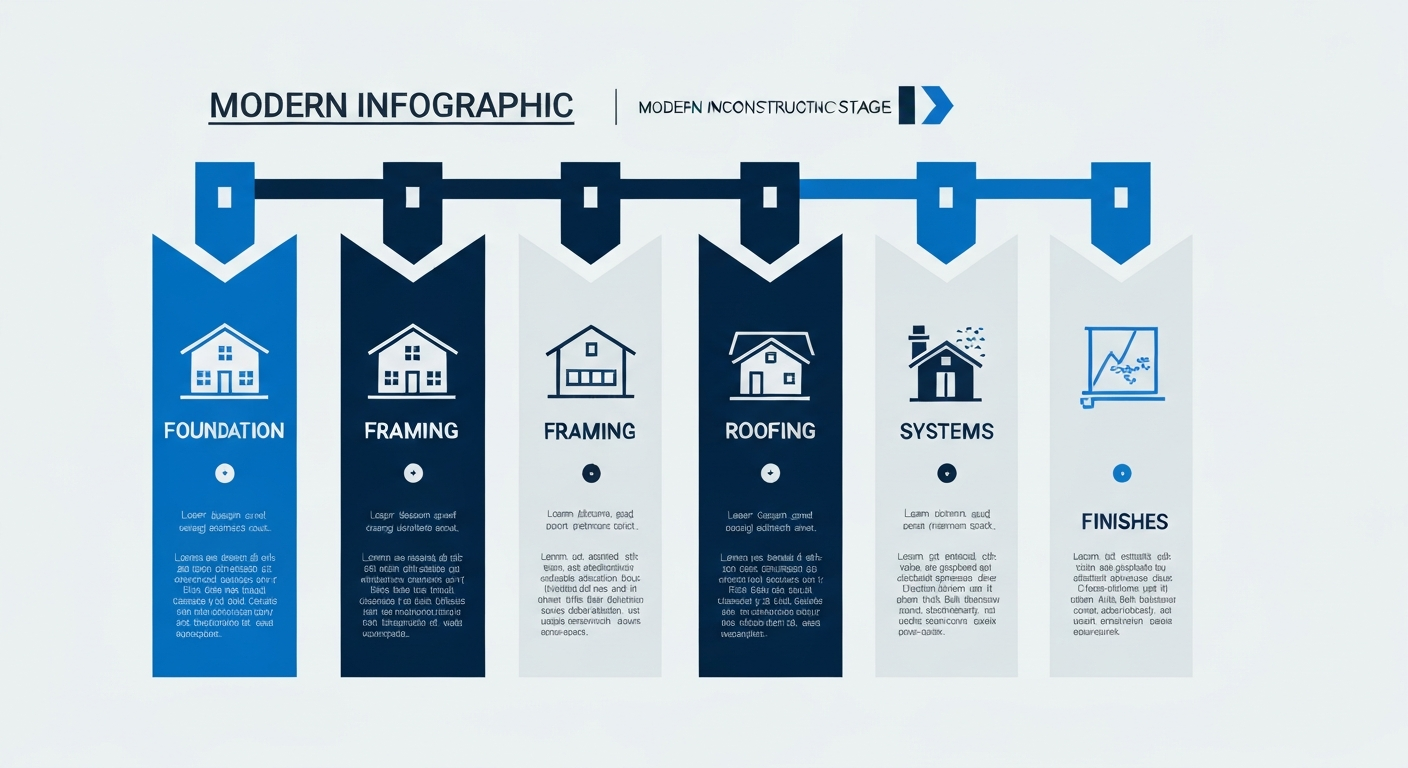
First, the money arrives in stages, not all at once. These stages are called draws, and each one is tied to a construction milestone: foundation poured, framing complete, roof on, systems installed, finishes done. Before releasing each draw, the lender typically sends an inspector to confirm the milestone actually happened. This protects the lender, but it also protects you: it keeps the project honest and the money flowing in step with real progress.
Second, payments during construction are usually interest-only, and only on what has been drawn. If your total loan is approved but only the foundation draw has been released, you pay interest on the foundation draw, not the whole amount. This keeps carrying costs manageable while you are likely also paying rent or a mortgage somewhere else.
Third, the loan has an expiration date. Construction loans are short-term by design. When the build is done, the loan either comes due in full, which most people handle by refinancing into a standard mortgage, or it converts automatically into one. That automatic version is called a construction-to-permanent loan, and it is popular for a simple reason: one application, one closing, one set of fees, and no need to requalify at the end of the build.
Because the lender is betting on something that does not exist yet, underwriting is noticeably more demanding. Expect the lender to scrutinize:
- Your builder's license, track record, and references
- The complete construction budget, line by line
- The project timeline and plans
- The projected value of the finished home
- And, of course, your own credit, income, and reserves
If that list feels heavy, it is. But it maps to real risk: unfinished houses are hard to sell, and cost overruns are common. Our home construction loan guide walks through every requirement and the full draw process step by step.
Side-by-side: the two loans compared
| Home equity loan | Construction loan | |
|---|---|---|
| Best for | Renovations, additions, remodels on a home you own | Building a new home from the ground up |
| How funds are released | Lump sum upfront | In stages (draws) tied to milestones |
| What secures the loan | Your current home's existing equity | The land and project, based on projected finished value |
| Payments during the project | Full principal and interest from day one | Usually interest-only, on the amount drawn |
| Approval complexity | Simpler: appraisal, credit, income | Heavier: builder vetting, budget review, plans, inspections |
| Term | Medium to long term, fixed installments | Short term, then paid off or converted to a mortgage |
| Borrowing ceiling | Capped by today's equity | Sized to the projected value of the finished home |
| Main risk to you | Your current home is on the line | Cost overruns and delays strain the financing |
When a home equity loan is the better choice
The pattern is consistent: home equity loans win when the project improves a home you already own and the cost fits comfortably inside your available equity. Let's make that concrete.
You are remodeling a kitchen or bathroom
These projects have defined scopes and defined budgets. There are no foundation pours for an inspector to verify, so a milestone-based draw system would be overkill. A lump sum upfront, paid to your contractor on the schedule you negotiate, is simpler and cleaner. If this is your project, start by sizing it properly: our breakdown of kitchen remodel costs will help you anchor the loan amount in reality instead of optimism.
You are adding a room or expanding the footprint
Additions sit in an interesting middle ground: they are construction, but on a property that already has appraisable value. Owners who have been paying a mortgage for several years often find their equity covers the addition entirely, which makes the equity loan the path of least resistance. The exception is a very large addition that pushes past your equity ceiling, which brings construction financing back into the conversation.
You are renovating a manufactured home
Owners of manufactured homes often assume financing options are closed to them. That is not always true. When the home qualifies, equity financing can fund a serious renovation, since the structure exists and can be appraised like any other collateral. The qualification details matter a lot here, and we cover them in our manufactured home remodel guide.
Predictability is worth money to you
This one is about temperament as much as math. A home equity loan gives you a fixed rate, a fixed installment, and a known payoff date. No draw schedules, no inspections, no conversion event at the end. For borrowers who have watched a friend's build spiral and want none of that energy in their lives, the simplicity itself is a feature worth choosing.
A note for Texas homeowners: Texas has specific constitutional rules governing home equity lending, including limits on how much of your equity you can borrow and how often you can do it. If you are in the state, read our guide to home equity loans in Texas before assuming the national rules apply to you.
When a construction loan is the better choice
Construction loans win when the project is a new build, or when the scope outgrows what your equity can fund. Again, concretely:
You are building a new home on land
This is the canonical case. There is no existing structure to borrow against, so a construction loan is usually the only realistic path. Before you even talk to a lender, know your number: building costs swing dramatically by location, and lenders will expect your budget to reflect local reality. Our state-by-state guide to home building costs shows just how much geography changes the math, and our deep dives on California, Texas, and Georgia get into the specifics for those markets.
You are doing a major structural rebuild
Taking a house down to the studs, or rebuilding after serious damage, behaves financially like new construction: big budget, staged work, real risk of surprises behind the walls. These projects often exceed equity limits, and honestly, they benefit from the discipline of the draw-and-inspect system. The oversight that feels bureaucratic on a kitchen remodel becomes genuinely useful when the project is large enough to go sideways.
You want the loan sized to the finished value, not today's value
Here is the structural advantage that equity loans cannot match: construction loans are underwritten against the projected value of the completed home. For ambitious projects, that ceiling is simply higher than anything your current equity can reach. You are borrowing against the future, with a lender who has verified that the future is buildable.
You are a first-time builder
Counterintuitive, but true: the construction-to-permanent structure was practically designed for people who have never done this before. One closing. One set of fees. Automatic conversion to a mortgage when the build wraps. No requalifying at the end, when your finances may look different than they did at the start. If this is you, our guide to construction loans for first-time home builders covers the specifics, including the mistakes first-timers make most often.
Can you use a home equity loan to build a house?
Yes, and it is worth addressing directly because plenty of people search for exactly this.
The scenario usually looks like this: you have substantial equity in your current home, and you want to build a smaller or lower-cost second property, perhaps a vacation home or a future retirement house. Using an equity loan means no draws, no inspections, no conversion event. You get the money, you build the house, done.
The tradeoffs deserve a hard look, though:
- You are risking your current home for a project on a different property. If the build goes wrong, the collateral at stake is the house your family lives in.
- You carry full principal-and-interest payments from day one, while simultaneously funding a construction project. That is a heavy monthly load compared to interest-only draws.
- Your ceiling is today's equity, not the finished home's value. For anything beyond a modest build, the math often just does not reach.
For most ground-up builds, the construction loan structure exists precisely because it handles all three of these problems better. The equity route makes sense mainly when the build is small relative to your equity, and you value simplicity enough to pay for it in monthly carrying costs.
The hidden costs on both sides
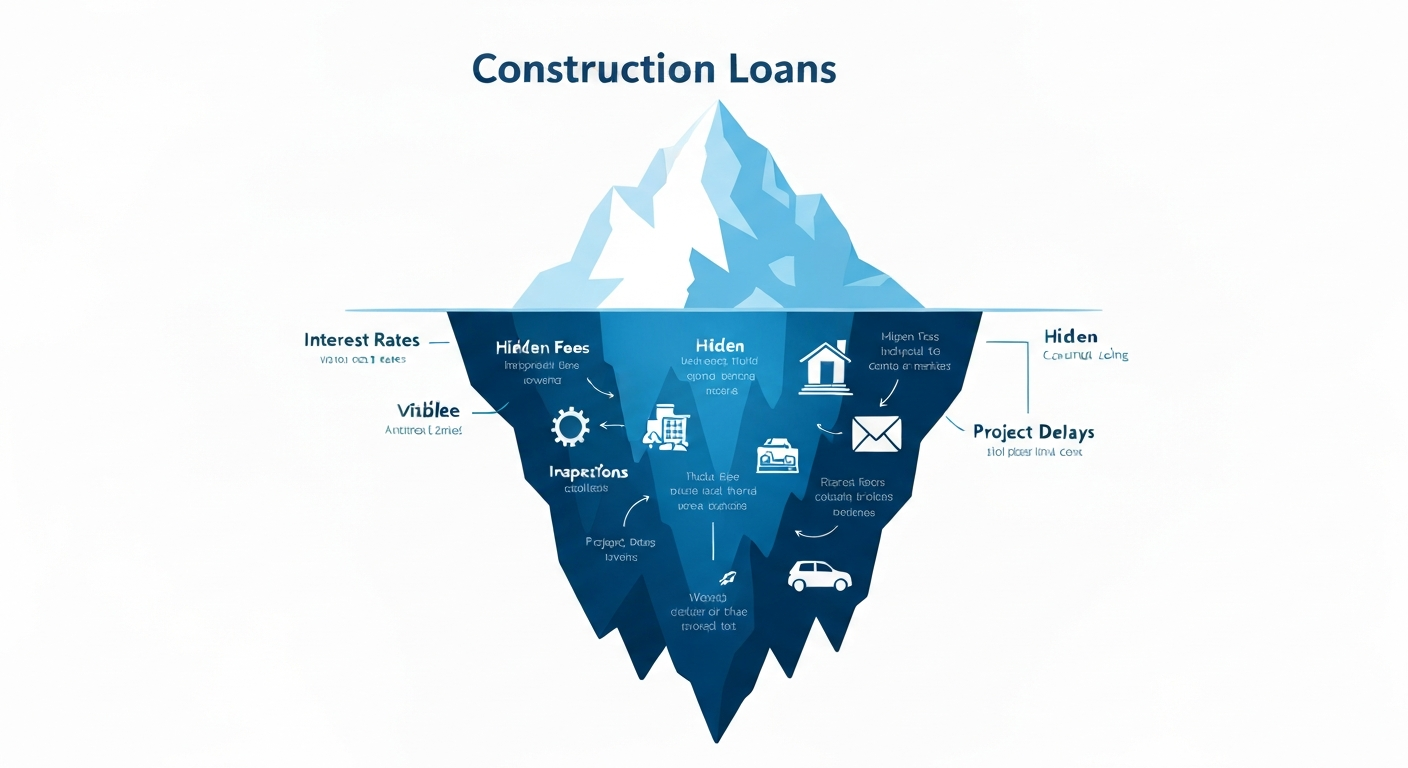
Neither loan's true cost lives in the interest rate alone, and comparing rates in isolation is the most common mistake borrowers make. Here is where the money hides:
On the construction loan side: inspection fees for every draw, potentially two closings if the loan is not construction-to-permanent, and the cost of delays. Every month the build runs long is another month of interest-only payments stacked on top of wherever you are currently living. Delay risk is not a footnote; for many borrowers it ends up being the single largest unplanned cost of the project.
On the home equity side: full payments start immediately, which means that during the project you are paying for the loan and the work and your existing mortgage all at once. There are also closing costs, and in some cases an early payoff has conditions worth reading twice.
On both sides: the cost of borrowing more than the project needs, or less. Oversizing a loan means paying interest on money that sits idle. Undersizing means going back for a second loan at whatever terms the market offers later. Both mistakes trace back to the same root cause: starting the financing conversation before the project budget is real.
How to run the numbers before deciding
Whichever way you lean, do the math in this order. The sequence matters.
Step 1: Estimate the total project cost first. Not roughly. Properly. Financing decisions made before the budget is real are the ones that go wrong. Use our construction cost calculator to build an estimate grounded in your project's actual scope, and if you are building new, sanity-check it against your state's cost profile.
Step 2: Calculate your available equity. Current market value, minus your mortgage balance, minus the cushion lenders require you to keep. That final number is your equity loan ceiling. If it clears the project cost with room to spare, the equity route is on the table. If it does not, you have your answer already.
Step 3: Compare total borrowing costs, not rates. Model the construction loan with its inspection fees and closing structure. Model the equity loan with full payments from day one. Run both against your actual timeline. Our construction loan calculator handles the draw-based scenario, which is genuinely hard to estimate by hand. For a walkthrough of LTV, LTC and draw schedules, read our guide on how to use the construction loan calculator.
Step 4: Stress test the timeline. Ask the uncomfortable question: if this project runs six months long, which structure hurts less? Construction delays extend the interest-only period and push out the conversion. Equity loan delays do not change your payment, but they extend the stretch where you are paying for two things at once. Neither answer is universally better; one of them is better for your cash flow, and you should know which before you sign.
Frequently asked questions
Which loan is easier to qualify for? Generally the home equity loan. The collateral already exists and has a verifiable market value, so underwriting is lighter. Construction loans add builder vetting, budget review, and plan approval on top of the standard credit and income checks.
Do construction loans require a bigger upfront commitment? Typically yes, relative to an equity loan, which requires no down payment because your existing equity plays that role. Exact requirements vary by lender and loan structure, which is one more reason to compare offers rather than assume.
What happens to a construction loan when the build is finished? One of two things: it comes due in full, which most borrowers handle by refinancing into a standard mortgage, or it converts automatically if it was structured as a construction-to-permanent loan from the start.
Can I combine both loans? Some owners do: an equity loan for the land purchase or early soft costs, and a construction loan for the build itself. It works, but it adds complexity and two sets of costs, so it earns its place mainly when neither loan alone covers the full project.
Is a HELOC the same as a home equity loan? No, and the difference matters for renovations. A HELOC is a revolving credit line you draw from as needed, with variable usage; a home equity loan is a fixed lump sum. For staged renovation spending, a HELOC loosely mimics a construction loan's draw rhythm, but without lender inspections and usually with a variable rate.
Does the loan choice affect my timeline? It can. Equity loans typically close faster, which matters if your contractor's start date is near. Construction loans take longer to approve because of the builder and plan review, so build that lead time into your project schedule.
The bottom line
Match the loan to the project, never the other way around.
Renovating or expanding a home you already own, with enough equity to cover it? The home equity loan gives you simplicity, predictability, and a faster close. Building new, or taking on something bigger than your equity can fund? The construction loan gives you a higher ceiling, staged funding that matches how construction actually happens, and lighter payments while the work is underway.
And in both cases, the decision becomes almost obvious once you hold a realistic project cost in your hands. So start there. Run your numbers through the construction cost calculator, check them against your market, and walk into the lender conversation already knowing what you need. Borrowers who do that do not get sold a loan. They choose one.