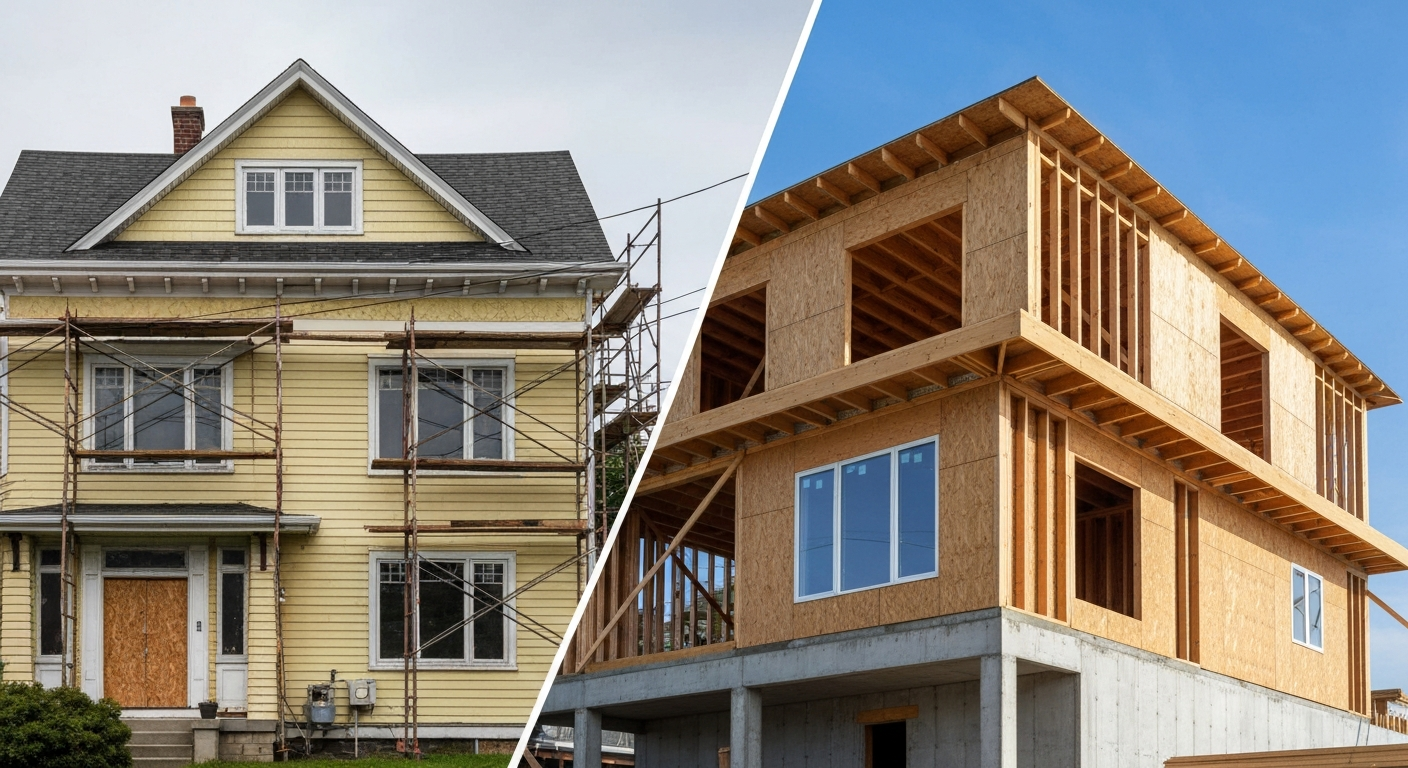
Building a home from the ground up is one of the most significant financial and personal milestones an American can achieve. According to the U.S. Census Bureau, new residential construction continues to represent a massive segment of the housing market, with hundreds of thousands of new single family homes authorized by building permits each year.
However, the path to building a custom home is fundamentally different from purchasing an existing property. The National Association of Home Builders notes that the average cost to build a new home has risen steadily, driven by labor shortages, material cost fluctuations, and regulatory requirements.
This environment makes securing the right financing absolutely critical. For most prospective builders, that financing comes in the form of a home construction loan. You can model these costs using our free Construction Loan Calculator.
Unlike a traditional mortgage that finances a completed asset, a home construction loan finances a project that does not yet exist. This introduces a layer of complexity that many first time homebuilders underestimate. You are not just proving your own creditworthiness; you are also proving the viability of the project, the competence of your builder, and the accuracy of your budget. If this is your first build, start with our first-time home builder construction loan guide.
The Consumer Financial Protection Bureau highlights that construction financing requires borrowers to navigate draw schedules, contingency funds, and specialized inspections. Understanding these mechanics is not just a matter of compliance. It is a matter of financial survival.
This comprehensive guide breaks down exactly how home construction loans work. We will explore the specific requirements you need to meet, the different types of loans available, and the step by step process to secure funding. To see how LTV, LTC and draw schedules affect your payments, read how to use the construction loan calculator.
More importantly, we will use real data from active American lenders, including Westmark Credit Union, Merrimack County Savings Bank, and First Merchants Bank, to illustrate exactly what you can expect in terms of fees, down payments, and loan structures.
We will also draw on technical insights from the Associated General Contractors of America to explain how lenders view risk and how you can position your project for approval.
If you are planning to build a custom home, relying on generic advice can lead to expensive mistakes. A misunderstanding of how construction period interest accrues or a failure to properly fund a contingency reserve can bring a project to a halt.
By the end of this guide, you will have a deep, data driven understanding of construction financing. You will know how to compare lender offers, how to prepare your application package, and how to manage the financial side of your build from the first shovel of dirt to the final Certificate of Occupancy.
For a broader perspective on the entire journey, read our detailed breakdown of the home building process step by step.
Quick answer: A home construction loan is a short-term loan that pays for building a home. Funds are released in stages as work progresses, and you make interest-only payments on the amount drawn until the loan is paid off or converted into a permanent mortgage.
- Construction phase typically lasts six to eighteen months
- Main types: construction-to-permanent (single close), stand-alone (two close) and owner-builder loans
- Most conventional lenders require a credit score of at least 680, with 720 and above getting the best rates
- Debt-to-income ratio should ideally be below 43%, and most conventional lenders ask for a 20% down payment
- LTV ratios generally range from 70% to 90%, based on a subject-to-completion appraisal
What Is a Home Construction Loan
A home construction loan is a short term financing instrument designed specifically to cover the costs associated with building a residential property. Unlike a standard mortgage, which is disbursed as a single lump sum to purchase an existing home, a construction loan is disbursed in stages as the building project progresses.
This staged disbursement process is designed to protect the lender by ensuring that the funds released correspond directly to the value added to the property through completed work.
The Associated General Contractors of America defines construction lending as a highly specialized form of real estate finance where the collateral is created over time. Because the physical asset does not exist at the time the loan is closed, the lender relies heavily on the projected future value of the completed home.
This future value is determined through a subject to completion appraisal, which evaluates the architectural plans, the specifications, and the lot value to estimate what the property will be worth once finished.
During the construction phase, which typically lasts between six and eighteen months, the borrower makes interest only payments. These payments are calculated only on the funds that have actually been disbursed, not on the total approved loan amount.
This structure helps keep monthly carrying costs manageable while the borrower may also be paying rent or a mortgage on their current residence. Once the construction is fully complete and the local municipality issues a Certificate of Occupancy, the short term construction loan must be resolved.
It is either paid off entirely or, more commonly, converted into a permanent long term mortgage.
It is crucial to understand that a home construction loan is inherently riskier for the lender than a traditional mortgage. If a borrower defaults on a standard mortgage, the bank can foreclose on the finished house and sell it to recover their funds.
If a borrower defaults on a construction loan halfway through the build, the bank is left with a partially finished structure that is incredibly difficult to sell. To mitigate this risk, lenders impose strict requirements on the builder, the budget, and the timeline.
They also require a higher level of oversight throughout the construction process, including mandatory site inspections before any funds are released. For a clear look at total expenses, read our breakdown on how much it costs to build a house.
How Does a Home Construction Loan Work
The process of securing and managing a home construction loan is fundamentally different from a traditional mortgage. It requires a high level of coordination between the borrower, the lender, and the builder.
The lifecycle of the loan begins with pre qualification, moves through a rigorous approval process, and enters the active construction phase, which is governed by the draw schedule. Finally, the loan concludes with the conversion to permanent financing.
The process begins when you approach a lender for pre qualification. This step determines your borrowing capacity based on your income, credit history, and existing debts. Once you know your budget, you can finalize your architectural plans and select a general contractor.
With plans and a builder in place, you submit a formal application. The lender then evaluates three distinct components: your personal finances, the builder's credentials, and the project's viability.
This involves ordering a subject to completion appraisal and reviewing the line item budget to ensure the costs are realistic and aligned with the projected value.
Once the loan is approved and closed, the active construction phase begins. The most critical element of this phase is the draw schedule. A draw schedule is a predetermined timeline for releasing funds.
Instead of handing the builder a check for the full loan amount, the lender releases money in increments, called draws, as specific milestones are reached. For instance, the first draw might cover site preparation and pouring the foundation.
When the builder completes this work, they request a draw. The lender then sends an independent inspector to the site to verify that the work has been completed according to the plans.
Only after the inspector approves the work does the lender release the funds to pay the builder. This process repeats for framing, plumbing rough ins, drywall, and interior finishes.

There are different ways lenders manage the interest during this period. Westmark Credit Union utilizes a draw note system that functions similarly to a line of credit. You only pay interest on the exact amount you have drawn down.
Other lenders use an escrow model where the entire loan amount is funded at closing into an escrow account, and you may end up paying interest on a larger portion of the funds earlier in the process.
The Associated General Contractors of America points out that accumulated construction period interest can be a significant cost, and borrowers must understand exactly how their lender calculates these monthly charges.
Once construction is complete, the final inspection is passed, and the Certificate of Occupancy is issued, the final draw is released. At this point, the short term construction loan must be settled.
In a construction to permanent loan, the balance automatically converts into a standard 15 or 30 year mortgage, and you begin making regular principal and interest payments.
Types of Home Construction Loans
Understanding the different types of home construction loans is essential for choosing the right financial product for your specific situation. The structure you choose will dictate your closing costs, your interest rate risk, and your long term financial strategy.
Construction-to-Permanent Loan
The construction to permanent loan, often referred to as a single close loan, is the most popular option for individuals building a custom primary residence. As the name suggests, this product combines the short term construction financing and the long term permanent mortgage into a single loan.
You close on the loan once, before construction begins. Lenders like Merrimack County Savings Bank and First Merchants Bank frequently use this model.
The primary advantage of a single close loan is risk mitigation. Your permanent interest rate is locked in upfront, protecting you from rate hikes during the 12 to 18 month construction period. Additionally, because there is only one closing, you only pay one set of closing costs, saving thousands of dollars.
Stand-Alone Construction Loan
A stand alone construction loan, also known as a two close loan, finances only the building phase. It is a short term loan that must be paid off entirely when the home is finished.
To pay off the balance, the borrower must secure a separate permanent mortgage, which requires going through the underwriting process a second time and paying a second set of closing costs.
This option carries more risk because if your financial situation changes during construction, or if interest rates spike, you may struggle to qualify for the permanent mortgage. However, it can be advantageous if you plan to sell your current home after the new build is finished and use the proceeds to pay off the construction loan in cash.
Owner-Builder Construction Loan
If you plan to act as your own general contractor, you will need an owner builder loan. These loans are notoriously difficult to secure. Lenders view owner builders as high risk because managing a construction site requires specialized expertise, established subcontractor relationships, and the ability to navigate complex permitting processes.
To qualify, you typically must prove that you are a licensed builder by trade or have extensive, documented experience managing similar projects.
Furthermore, lenders often charge higher fees for this route to offset the perceived risk. For example, Merrimack County Savings Bank charges a loan fee of 1 percent for projects with a general contractor, but that fee doubles to 2 percent if you act as a self GC.
Renovation Construction Loan
If you are purchasing a fixer upper that requires major structural work, a renovation loan is the appropriate tool. Similar to a new build loan, the lender bases the loan amount on the future appraised value of the home after the renovations are complete.
First Merchants Bank offers programs that allow borrowers to finance up to 90 percent of this to be completed value. This is ideal for massive overhauls, room additions, or structural repairs where a standard home equity loan would not provide sufficient capital.
Mini-Perm Loan
While more common in commercial development, mini perm loans are sometimes used by residential real estate investors building multi unit properties or spec homes.
According to the AGC, these loans typically have a term of 5 to 7 years. They cover the construction phase and provide a few years of stabilization, allowing the developer to lease the property and generate income before securing long term financing or selling the asset.
Home Construction Loan Requirements
Qualifying for a home construction loan is significantly harder than qualifying for a standard mortgage. Because the lender is taking on more risk, they require a stronger financial profile from the borrower and a thoroughly vetted project plan.
Credit Score and Financial Health: Most conventional lenders require a minimum credit score of 680 to qualify for a construction loan, though a score above 720 will secure the best rates. Your debt to income (DTI) ratio should ideally be below 43 percent. Lenders want to see a stable employment history and sufficient liquid reserves to cover unexpected expenses during the build.
Down Payment Requirements: The down payment requirements for construction loans are steep. While some government backed programs allow lower entries, most conventional lenders require a 20 percent down payment. If you would rather borrow against a home you already own, see home equity loan vs. construction loan.
However, lenders like Merrimack County Savings Bank offer options with a minimum of 5 percent down for highly qualified borrowers. If you already own the land, the equity in the lot can often be applied toward this down payment requirement, which is a significant advantage for borrowers who have held their land for several years.
Builder Approval Process: You cannot simply hire a friend with a truck to build your home. The lender must approve your general contractor. First Merchants Bank requires builders to pass a rigorous registration process.
This includes a background check, verification of state licenses, a soft pull of credit, and proof of adequate insurance. The lender wants to ensure the builder has the financial stability and the operational capacity to complete the project on time and on budget.
The Appraisal: The lender will order an appraisal based on the architectural plans and specifications, known as a subject to completion appraisal. The appraiser compares your future home to recently sold homes in the area to ensure the projected value supports the loan amount.
If the appraisal comes in low, you must cover the difference in cash or redesign the project to lower the costs. LTV ratios for construction loans generally range from 70 percent to 90 percent, depending on the lender and the borrower's profile.
Builder's Risk Insurance: You or your builder must carry Builder's Risk Insurance. This is a specialized policy that protects the structure and materials on site against damage, fire, or theft during construction. First Merchants Bank explicitly requires that this policy be converted to standard Homeowners Insurance upon completion of the project.
How to Get a Construction Loan Step by Step
Securing the loan is a methodical process that requires coordination between you, your builder, and your lender. Following the workflow typical of institutions like First Merchants Bank, the process looks like this:
First, get pre qualified. This establishes your budget before you spend thousands of dollars on architectural plans. Second, finalize your blueprints and get a detailed, line item budget from your chosen builder.
Third, submit your formal application package. This includes your personal financial documents, the builder's credentials, the plans, and the budget.
Once your project package is complete, you submit your formal loan application. This package includes your personal financial documents, the land deed or purchase agreement, the blueprints, the budget, and the builder's credentials.
The lender will immediately initiate the builder approval process. Using the protocols outlined by First Merchants Bank, the lender's risk department will verify the builder's license, insurance, and financial standing.
Simultaneously, the lender will order the subject to completion appraisal. The appraiser will review your plans and compare them to local market data. This is often the most stressful part of the process, as a low appraisal can force you to inject more cash or redesign the home to lower costs.
After underwriting reviews and approves all elements, you move to closing. At closing, you pay your down payment and closing costs. The lender then sets up the draw schedule and the funds are ready to be disbursed as construction begins.
Throughout the build, you will manage the draw process, requesting inspections and authorizing payments to the builder. Finally, when the home is complete, the loan converts to permanent financing.
Understanding the Draw Process
The draw process is the heartbeat of a construction loan. It is the mechanism that ensures the builder is paid for work completed while protecting the lender and the homeowner from paying for incomplete or substandard work.
When a phase of construction is finished, the builder submits a draw request to the lender. The lender does not take the builder's word for it. They dispatch a third party inspector to the site.
The inspector verifies that the foundation is poured, or the framing is complete, exactly as outlined in the plans. Only after the inspector signs off does the lender disburse the funds.
Lenders also require title endorsements and lien waivers before releasing funds. A lien waiver is a document signed by the builder and subcontractors stating they have been paid for that phase of work, preventing them from placing a mechanic's lien on your property.
At the end of the project, lenders typically hold back a percentage of the final draw (First Merchants Bank requires a minimum of 5 percent) until the local municipality issues a Certificate of Occupancy and the final punch list is complete.
Construction Loan Terms You Should Know
Navigating the paperwork requires understanding the industry vocabulary. Here are the essential terms based on definitions from the AGC and standard lender practices.
| Term | Definition |
|---|---|
| Draw Schedule | The detailed timeline and payment plan that dictates when and how much money the lender will release to the builder as specific project milestones are met. |
| Escrow Model | A funding method where the entire loan amount is placed in an account at closing, and interest may accrue on the full balance. |
| Draw Note | A funding method acting like a line of credit, where interest is charged only on the funds that have been disbursed. |
| Contingency Reserve | A mandatory budget buffer, usually 5% to 10% of total costs, set aside to cover unexpected expenses or cost overruns. |
| Subject to Completion Appraisal | An appraisal based on the future value of the home, calculated using the architectural plans and specifications. |
| Builder's Risk Insurance | A specialized insurance policy that protects the structure and materials on site against damage, fire, or theft during construction. |
| Certificate of Occupancy (CO) | A document issued by local government certifying the building meets all codes and is safe for habitation. |
| Change Order | A formal written document detailing any modification to the original construction plans or budget. |
| Lien Waiver | A legal receipt from a contractor or subcontractor relinquishing their right to place a mechanic's lien on the property for work they have been paid for. |
| Loan to Value (LTV) | The ratio of the loan amount to the appraised value of the completed property. |
| Debt to Income (DTI) | The percentage of your gross monthly income that goes toward paying debts, used to determine qualification. |
| Soft Pull | A credit check that does not affect your credit score, often used during the initial builder or borrower vetting process. |
| Hard Costs | The tangible costs of construction, including labor, lumber, concrete, and physical materials. |
| Soft Costs | The intangible costs of a project, such as architectural fees, permits, engineering reports, and loan fees. |
| Single Close Loan | Another term for a construction to permanent loan, requiring only one closing process. |
How Construction Loans Differ from Traditional Mortgages
The differences between these two financial products are profound. A traditional mortgage is a straightforward transaction for a finished product. A construction loan is a dynamic, actively managed financial tool for a project in motion.
| Feature | Construction Loan | Traditional Mortgage |
|---|---|---|
| Disbursement | Paid out in staged draws over time | Paid out in a single lump sum at closing |
| Interest Rate | Typically variable during construction | Usually fixed for the life of the loan |
| Payments | Interest only on the drawn balance | Principal and interest on the full balance |
| Term Length | Short term (6 to 18 months) | Long term (15 to 30 years) |
| Collateral | Future value of an unbuilt home | Current value of an existing home |
| Approval Focus | Borrower finances AND builder vetting | Borrower finances and property condition |
| Appraisal | Based on blueprints and future value | Based on current physical condition |
| Inspections | Multiple inspections tied to fund release | Single inspection before closing |
Real Cost Breakdown: What You Actually Pay
The cost of a construction loan goes beyond the interest rate. There are structural fees and carrying costs that you must account for in your budget.
Origination and Loan Fees: Lenders charge fees to set up the loan. Westmark Credit Union, for example, typically charges a 1 percent origination fee on the draw note, and another 1 percent when it converts to a mortgage. Merrimack County Savings Bank charges 1 percent for the first US$500,000.
Inspection Fees: Every time a draw is requested, an inspector must visit the site. Merrimack includes the first 8 inspections in their fee, but charges US$150 for each additional visit.
Contingency Funds: You are required to hold cash in reserve. If your project costs US$400,000, a 5 percent contingency means you must have US$20,000 set aside. If you act as your own GC, lenders may require a 10 percent contingency.
The difference between a draw note and an escrow model is also financially significant. Consider a US$400,000 loan over 12 months at 7 percent interest.
COST COMPARISON: Draw Note vs Escrow Model
(Hypothetical US$400,000 project over 12 months at 7% interest)

Draw Note Model:
You only pay interest on funds as they are released.
Average outstanding balance over the year: US$200,000
Estimated total construction interest: US$14,000

Escrow Model:
Entire US$400,000 is funded into an account at closing.
If interest accrues on the full amount from day one:
Estimated total construction interest: US$28,000

Financial Impact:
The draw note model can save you US$14,000 in carrying costs
simply based on how the lender structures the disbursement.
Tips to Save Money on a Home Construction Loan
Managing the loan efficiently can save you thousands of dollars. Here are practical strategies based on how lenders structure these products.
- Use your down payment smartly: If your lender allows it, use your cash down payment to fund the early stages of construction before touching the loan funds. This delays the accrual of interest on the bank's money.
- Seek out draw note structures: As demonstrated above, finding a lender like Westmark that uses a line of credit style draw note will significantly reduce your interest burden compared to a full escrow model.
- Minimize change orders: Every time you change the plan, you risk exceeding your budget. If you exhaust your contingency fund, you will have to pay out of pocket, or the lender may halt the project.
- Lock in your permanent rate: Choose a construction to permanent loan to lock in your long term interest rate upfront, protecting yourself from market volatility during the 12 month build.
- Vet your builder aggressively: A delayed project means more months of paying construction period interest. Hire a builder with a proven track record of finishing on time to minimize your carrying costs.
Red Flags That Can Derail Your Construction Loan
The AGC of America identifies several risk factors that can cause a construction loan to fail. As a borrower, you must be vigilant against these red flags.
An unregistered or unverified builder is a non starter. Lenders like First Merchants Bank have rigorous builder approval processes. If your chosen contractor refuses to submit to background checks, cannot produce valid insurance certificates, or has a history of unpaid subcontractors, the bank will not fund the project. You must vet your builder as thoroughly as the bank will.

Financing in layers without a strong primary lead is another warning sign. If you are trying to piece together funding from a personal loan, a land loan, and a construction loan from different institutions, the complexity increases the risk of failure. A unified financing strategy, such as a construction to permanent loan, provides stability and clear lines of communication.
The most dangerous scenario is the loan going upside down. This happens when the cost to complete the project exceeds the remaining funds in the loan, usually due to unapproved change orders or severe material price spikes. When this occurs, the lender will freeze all disbursements until the borrower injects enough personal cash to close the gap.
Common Mistakes to Avoid
First time builders often make predictable errors that cost them dearly. The most common mistake is failing to budget for overlapping housing costs.
While your new home is being built, you still have to pay rent or the mortgage on your current residence, plus the interest only payments on the construction loan. You must ensure your cash flow can handle this double burden for up to 18 months.
Another mistake is treating the contingency fund as extra spending money. The contingency is for emergencies, like hitting bedrock during excavation or a sudden spike in lumber prices. If you use it to upgrade your kitchen countertops, you will have no safety net when a real structural issue arises.
Finally, ignoring the strict rules of the draw schedule can cause severe friction. Borrowers sometimes try to pay subcontractors directly or ask the builder to start work on a phase before the previous phase has been inspected and funded.
You must follow the lender's protocol exactly. The bank will not release funds without an inspection, and bypassing the process can result in lien issues or frozen disbursements. Be sure to explore all types of residential construction methods before finalizing your loan.
FAQ Section
What credit score is needed for a home construction loan? Most conventional lenders require a minimum credit score of 680 to qualify for a home construction loan, though many prefer scores above 720 to offer the most competitive interest rates. The higher requirement reflects the elevated risk of financing an unbuilt asset. Government backed programs, such as FHA construction loans, may accept lower scores, sometimes down to 500 with a larger down payment, but individual lenders often apply their own stricter overlays.
Can I use my land equity as a down payment? Yes. If you already own the lot where the home will be built, most lenders will allow you to use the equity in that land toward your required down payment. This is a significant advantage for borrowers who have held their land for several years and seen its value appreciate.
How long does it take to get approved for a construction loan? The approval process for a construction loan typically takes between 30 and 45 days. This is longer than a standard mortgage because the lender must not only underwrite your personal finances but also review the architectural blueprints, approve the project budget, and rigorously vet the general contractor.
Are there FHA construction loans available for first time builders? Yes, the FHA offers a one time close construction loan that requires a much lower down payment (as low as 3.5 percent) and has more forgiving credit score requirements than conventional loans. However, the loan limits are capped by county, and the property must serve as your primary residence.
What happens if the construction takes longer than expected? If your build exceeds the loan term, you will need to request an extension from your lender. Lenders typically grant 90 day extensions, but they often come with extension fees. Furthermore, you will continue to pay construction period interest for every additional month the project is delayed.
Do I pay principal during the construction phase? No. During the active construction phase, your monthly payments are strictly interest only, and they are based only on the amount of money that has been drawn down to date, not the total loan amount. You do not begin paying principal until the home is complete and the loan converts to a permanent mortgage.
What is a subject to completion appraisal? Unlike a standard appraisal that evaluates an existing home, a subject to completion appraisal estimates what the home will be worth once it is fully built. The appraiser uses your architectural plans, specifications, and lot value, comparing them to recently sold homes of similar size and quality in the area.
Why does the lender hold back money at the end of the project? Lenders typically withhold a percentage of the final draw, often 5 to 10 percent, to ensure that the builder finishes the final punch list items and that the local government issues a Certificate of Occupancy. This holdback protects the homeowner from a builder abandoning the project right before the final details are completed.
Can I include the cost of the land in the construction loan? Yes, if you do not already own the land, you can often include the purchase price of the lot in the total construction loan. This is commonly referred to as a "land and construction loan." The lender will base the loan on the combined value of the land and the projected value of the completed home.
What is a soft pull of credit, and why do lenders use it? A soft pull of credit is a preliminary credit check that does not affect your credit score. Lenders often use a soft pull during the initial pre-qualification phase to gauge your financial health before moving forward with a formal, hard credit inquiry during the underwriting process.
Conclusion
Securing a home construction loan is a rigorous process that demands financial discipline, meticulous planning, and a strong partnership with a vetted builder. By understanding the mechanics of the draw schedule, the difference between a draw note and an escrow model, and the strict requirements for builder approval, you can navigate the process with confidence.
Remember that the lender's stringent oversight, while sometimes frustrating, is ultimately designed to protect your investment. Choose a lender experienced in construction financing, maintain your contingency reserve, and you will be well positioned to turn your blueprints into reality.
For a deeper dive into managing the costs of your build, try our Construction Loan Calculator to model your potential payments.