Quick answer: a manufactured home remodel typically costs $5,000 to $15,000 for a cosmetic refresh (new flooring, paint and updated fixtures) and $40,000 to $80,000 or more for a comprehensive renovation of the kitchen, bathrooms, flooring, roof and insulation. Homes built since June 15, 1976 must meet the HUD Code, which affects what you can change, and the guide recommends budgeting a minimum 15% contingency.
Manufactured homes represent about 6% of all occupied housing in the United States, according to the U.S. Census Bureau, and millions of Americans live in them full time. Many were built decades ago. They age. They need updating. And their owners, at some point, face the same question: is remodeling worth it, where do you start, and what makes a manufactured home remodel different from remodeling a site-built house or other types of residential construction?
The answer to the first question is often yes, but with conditions. A well-executed manufactured home remodel can meaningfully increase comfort, livability, and market value. A poorly planned one can cost more than it returns and create structural or moisture problems that compound over time.
This guide covers everything you need to know before starting a manufactured home remodel, including what is different about these homes structurally, which projects deliver the best return, how to finance the work, and how to avoid the most common and costly mistakes.
What Makes a Manufactured Home Different From a Site-Built Home
Understanding the structural characteristics of a manufactured home is the foundation of any successful remodel. Manufactured homes are built to the HUD Code (the federal Manufactured Home Construction and Safety Standards), not to local building codes the way site-built homes are. This distinction has practical consequences for every remodeling project you undertake.
The HUD Code and what it means for remodeling:
Since June 15, 1976, all manufactured homes built in the United States have been required to meet HUD Code standards. Homes built before that date were built to no uniform federal standard and are generally referred to as mobile homes. The terminology matters because lenders, insurers, and contractors often treat pre-1976 and post-1976 homes differently.
Any addition to a manufactured home, or any work that changes the structure from its original HUD-approved configuration, must be done in compliance with HUD guidelines. In most states, this means that structural changes require permits and inspections, just as they would for a site-built home.
Wall construction:
Most manufactured homes use 2x3 or 2x4 framing with walls that are typically thinner than site-built construction. Exterior walls are often 3.5 inches thick rather than the 5.5 inches common in site-built homes. This affects insulation options, the way outlets and fixtures are mounted, and the way additions connect to the existing structure.
Roof systems:
Manufactured home roofs are typically low-pitch designs with a roof-over option being a common remodel project. The trusses are engineered specifically for the original structure and may not support the added weight of certain roofing materials without engineering review.
Flooring systems:
The floor system in a manufactured home is built on a steel chassis. The subfloor is typically particle board or oriented strand board (OSB), and it is more vulnerable to moisture damage than the subfloor in most site-built homes. Flooring replacement is one of the most common manufactured home remodel projects, and moisture management is the central concern.
Plumbing and electrical:
Manufactured home plumbing uses plastic supply lines (typically polybutylene in older homes, PEX in newer ones) and the electrical system uses aluminum wiring in many pre-1990 homes. Both have implications for remodeling. Polybutylene has a documented failure history and many remodelers replace it proactively. Aluminum wiring requires specific connectors and outlets that differ from copper wiring standards.
The table below summarizes the key structural differences between manufactured homes and site-built homes as they apply to remodeling (similar to the home building process step by step):
| Feature | Manufactured Home | Site-Built Home | Remodeling Implication |
|---|---|---|---|
| Building code | HUD Code (federal) | Local/state building codes | Permits and inspections still apply to remodel work |
| Wall thickness | Typically 3.5 inches | Typically 5.5 inches | Limits some insulation and finish options |
| Subfloor material | Particle board or OSB | Plywood or OSB | Higher moisture vulnerability, check before any flooring work |
| Roof pitch | Low pitch (typically 3/12 or lower) | Varies widely | Weight limits apply, roof-overs are a common solution |
| Plumbing (pre-1990) | Often polybutylene | Copper or CPVC | Consider proactive replacement |
| Electrical (pre-1990) | Often aluminum wiring | Copper wiring | Requires specific connectors and outlets |
| Foundation | Steel chassis, pier and beam | Continuous perimeter or slab | Leveling may be needed before interior remodel |
| Structural permits | Required for changes | Required for changes | Always check with local jurisdiction |
The Most Valuable Manufactured Home Remodel Projects
Not all remodeling projects deliver the same return in a manufactured home. Some improvements increase livability dramatically and add measurable market value. Others consume budget without proportional benefit.
The projects below consistently deliver the best combination of livability improvement, cost efficiency, and market value return in manufactured homes.
Flooring replacement:
Flooring is the single most impactful cosmetic improvement in a manufactured home. Original flooring in older manufactured homes is often worn, stained, or damaged by moisture. Replacing it with luxury vinyl plank (LVP) is the standard choice for most manufactured home remodels: LVP is waterproof, durable, installs directly over most subfloors, and gives the interior a modern appearance at a cost that is accessible for most budgets.
Before installing any new flooring, inspect and repair the subfloor. Soft spots, delamination, and moisture damage in the particle board subfloor are common in older manufactured homes, particularly under kitchens and bathrooms. Addressing subfloor damage before laying new flooring is non-negotiable. Installing new flooring over a compromised subfloor is one of the most common and expensive remodeling mistakes in this housing category.
Kitchen updates:
Kitchen updates in manufactured homes follow the same logic as in any home, with one important consideration: cabinet sizing. Manufactured home cabinets are often built to non-standard dimensions. Replacing them with standard residential cabinets requires careful measurement and may require custom sizing or modification. Many remodelers choose to reface existing cabinets rather than replace them, which delivers a significant visual update at a fraction of the cost of full replacement. For general budgeting benchmarks, see our kitchen remodel cost guide.
Bathroom renovation:
Bathrooms in older manufactured homes often feature tub and shower surrounds that are bonded directly to the wall, making removal and replacement more involved than in a site-built home. Water damage behind original surrounds is common. A full bathroom renovation in a manufactured home should include inspection and replacement of any damaged wall material behind the original fixtures. Our bathroom remodel cost guide breaks down typical line items and how to budget for waterproofing.
Roof-over installation:
Installing a new pitched roof over the original low-pitch roof is one of the most structurally and financially significant improvements available to manufactured homeowners. A roof-over serves multiple purposes: it provides additional weatherproofing over aging original roofing materials, it improves the visual appearance of the home significantly, and it creates attic space that can be insulated for improved energy performance.
Insulation upgrades:
Original insulation in manufactured homes built before the mid-1990s is often below the efficiency standards of modern construction. Adding insulation in the belly board (the underside of the floor), the roof cavity, and around the perimeter skirting is one of the highest-return improvements available in terms of ongoing energy cost reduction.
Exterior siding replacement:
Original exterior siding on older manufactured homes is typically thin aluminum or low-quality vinyl that degrades over time. Replacing it with heavier gauge vinyl siding or fiber cement board improves weatherproofing, insulation, and curb appeal significantly. For exterior upgrades that pay back, see our guides to maximizing curb appeal and choosing exterior paint for harsh weather climates.
The table below shows approximate costs and return profiles for the most common manufactured home remodel projects:
| Project | Typical Cost Range | Livability Impact | Market Value Impact | DIY Feasibility |
|---|---|---|---|---|
| LVP flooring (full home) | $2,500 - $7,000 | Very high | High | Moderate |
| Subfloor repair (per affected area) | $500 - $3,000 | Essential (structural) | High | Low-moderate |
| Kitchen cabinet refacing | $1,500 - $5,000 | High | Moderate-high | Low |
| Full kitchen renovation | $8,000 - $25,000 | Very high | High | Low |
| Bathroom renovation | $4,000 - $12,000 | High | Moderate-high | Low |
| Roof-over installation | $6,000 - $15,000 | High | High | Very low |
| Insulation upgrade (full home) | $2,000 - $6,000 | High | Moderate | Low |
| Exterior siding replacement | $5,000 - $14,000 | High | High | Very low |
| Interior paint (full home) | $800 - $2,500 | Moderate-high | Moderate | High |
| Window replacement | $3,000 - $10,000 | High | Moderate-high | Low |
REMODEL PROJECT PRIORITY MATRIX
(Return on investment vs difficulty of execution)

High Return / Lower Difficulty:
  - LVP flooring replacement
  - Interior paint
  - Cabinet refacing

High Return / Higher Difficulty:
  - Subfloor repair and replacement
  - Bathroom renovation
  - Roof-over installation
  - Exterior siding replacement

Moderate Return / Lower Difficulty:
  - Fixture updates (faucets, lighting, hardware)
  - Landscaping and curb appeal
  - Deep cleaning and staging

Moderate Return / Higher Difficulty:
  - Full kitchen renovation
  - Window replacement
  - Insulation upgrade
How Much Does a Manufactured Home Remodel Cost
The cost of a manufactured home remodel varies as widely as the scope of the work. A focused cosmetic refresh, including new flooring, paint, and updated fixtures, can be completed for $5,000 to $15,000. A comprehensive renovation addressing the kitchen, bathrooms, flooring, roof, and insulation can reach $40,000 to $80,000 or more.
The table below provides a framework for budgeting a manufactured home remodel by scope:
| Remodel Scope | What Is Included | Typical Cost Range |
|---|---|---|
| Cosmetic refresh | Paint, flooring, fixtures, hardware | $5,000 - $15,000 |
| Kitchen and bath update | Cabinet refacing, new counters, new fixtures | $12,000 - $30,000 |
| Structural and systems | Roof-over, insulation, plumbing or electrical update | $15,000 - $35,000 |
| Full interior renovation | Kitchen, baths, flooring, paint, fixtures, windows | $35,000 - $65,000 |
| Comprehensive renovation | All of the above plus roof, siding, and insulation | $55,000 - $90,000+ |
A few cost factors that are specific to manufactured home remodels and that often surprise first-time renovators looking into how much it costs to build or renovate a home:
Subfloor repairs add up quickly. In older manufactured homes, subfloor damage from moisture is common and often more extensive than it appears from the surface. Budget for subfloor repair separately, and do not assume the flooring cost covers it.
Non-standard dimensions increase material costs. Cabinets, doors, and windows in manufactured homes are often non-standard sizes. Replacement with standard residential products sometimes requires modification or custom fabrication.
Access and leveling may be prerequisites. If the home has settled unevenly on its piers, leveling is necessary before interior finish work. Leveling a manufactured home typically costs $500 to $2,000 and is often required before flooring installation will produce a satisfactory result.
Contractor availability varies by market. Not all contractors are experienced with manufactured home construction. In some markets, finding a contractor with genuine manufactured home remodeling experience requires research and patience. A contractor unfamiliar with the structural differences may create problems that cost more to fix than the original work cost.
SAMPLE BUDGET: Full Interior Renovation
(1,200 sq ft double-wide manufactured home, approximate)

Item                              Low Estimate    High Estimate
---------------------------------------------------------------
Subfloor inspection and repair      $1,500          $5,000
LVP flooring (full home)            $2,800          $6,500
Kitchen cabinet refacing            $2,000          $5,500
Kitchen countertops                 $1,500          $4,500
Kitchen appliances                  $2,500          $6,000
Bathroom renovation (1 full bath)   $4,500         $10,000
Bathroom renovation (1 half bath)   $2,000          $5,000
Interior paint (full home)          $1,200          $2,800
Lighting and fixture updates        $800            $2,500
Window replacement (6 windows)      $3,000          $7,500
Contingency (15%)                   $3,500          $8,300
---------------------------------------------------------------
Total                              $25,300         $63,600
Financing a Manufactured Home Remodel
Financing a manufactured home remodel is often more complex than financing renovations to a site-built home. The options available depend on whether the home is classified as real property or personal property, whether the land is owned or leased, and the age and condition of the home.
The real property versus personal property distinction:
A manufactured home that is permanently affixed to a foundation on land the owner owns is typically classified as real property and can be financed with conventional mortgage products including home equity loans and home equity lines of credit (HELOCs). A manufactured home on leased land, or one that has not been converted to real property, is typically classified as personal property (a chattel loan), which carries higher interest rates and fewer product options.
Converting a manufactured home from personal property to real property, by permanently affixing it to a foundation and recording the conversion with the county, can significantly expand financing options and reduce long-term borrowing costs.
Home equity loan for remodel:
For manufactured homeowners who own their land and have built equity, a home equity loan is one of the most cost-effective ways to finance significant remodeling work. Home equity loans offer fixed interest rates, fixed monthly payments, and typically lower rates than personal loan products.
The qualification requirements are similar to a conventional home equity loan: sufficient equity in the home, acceptable credit score (typically 620 or higher for most lenders), and income verification. Some lenders have restrictions on manufactured homes for equity products, so shopping multiple lenders is important. For a full explanation of how these loans work, read what a home equity loan is.
Home remodel tax credit:
Certain energy-efficiency improvements to a manufactured home may qualify for federal tax credits. The Residential Clean Energy Credit covers solar panels, solar water heaters, and battery storage systems. The Energy Efficient Home Improvement Credit covers insulation, windows, doors, and certain HVAC upgrades. These credits are available to manufactured homeowners who use the home as a primary residence.
The table below summarizes the main financing options for manufactured home remodels:
| Financing Option | Best For | Typical Rate | Typical Terms | Key Requirement |
|---|---|---|---|---|
| Home equity loan | Large projects, real property homes | 7-10% fixed | 5-15 years | Sufficient equity, land ownership |
| HELOC | Ongoing or phased projects | Variable (prime + margin) | Draw period + repayment | Sufficient equity, land ownership |
| Personal loan (unsecured) | Smaller projects, chattel homes | 10-20% | 2-7 years | Credit score and income |
| FHA Title I loan | Manufactured home improvements | 7-12% | Up to 20 years | HUD-approved lender |
| Cash-out refinance | Large projects with sufficient equity | Current mortgage rates | 15-30 years | Real property, sufficient equity |
| Contractor financing | Small to medium projects | Varies widely | 6-60 months | Contractor program availability |
The FHA Title I loan is specifically designed for manufactured home improvements and is worth knowing about when exploring home equity loans and renovation financing. It does not require equity in the home, which makes it available to owners who have not yet built substantial equity. Maximum loan amounts are $25,090 for a manufactured home and $69,678 for a manufactured home on real property. The program is available through HUD-approved lenders.
Mobile Home Remodel Versus Manufactured Home Remodel: What Is Different
The terms mobile home and manufactured home are often used interchangeably in casual conversation, but they describe different things, and the distinction matters for remodeling.
A mobile home, technically speaking, is a factory-built home constructed before June 15, 1976, when the HUD Code took effect. These homes were built to varying standards with no uniform federal code, and many are now 50 or more years old. A manufactured home is a factory-built home constructed after June 15, 1976, to HUD Code standards.
The practical remodeling differences are significant:
Age-related issues in pre-1976 homes: Homes built before the HUD Code was implemented are more likely to have original plumbing, wiring, and insulation that is not just outdated but potentially hazardous. Knob-and-tube-style wiring, hazardous materials, and original low-efficiency insulation are more common in these older homes.
Hazardous materials: Homes built before 1978 may contain lead-based paint. Homes with certain types of original insulation may contain asbestos. Any renovation work that disturbs these materials requires proper handling procedures and, in many cases, licensed remediation.
Structural condition: Pre-1976 homes were not built to a uniform standard, and structural condition varies widely. Before investing in a cosmetic remodel of a pre-1976 home, a thorough structural assessment is advisable.
Insurance and financing limitations: Many insurers and lenders have restrictions on homes built before 1976. This can affect both your ability to finance remodel work and the insurability of the completed renovation.
The table below compares the remodeling considerations for pre-1976 mobile homes and post-1976 manufactured homes:
| Factor | Pre-1976 Mobile Home | Post-1976 Manufactured Home |
|---|---|---|
| Building standard | None (no HUD Code) | HUD Code compliant |
| Hazardous materials risk | Higher (lead paint, possible asbestos) | Lower |
| Financing availability | More limited | Broader options |
| Insurance availability | More limited | Standard manufactured home products |
| Structural predictability | Lower | Higher |
| Remodel complexity | Higher on average | Moderate |
| Recommended first step | Full structural and hazmat assessment | Subfloor and moisture inspection |
For owners of pre-1976 homes, the recommendation before beginning any significant remodel work is a professional inspection, much like what you need to know before buying other types of new homes.
Trailer Home Remodel: Addressing the Terminology
The term trailer home is informal and carries associations that the manufactured housing industry has worked for decades to move away from. In practical remodeling terms, when people search for trailer home remodel, they are typically looking for the same information that applies to manufactured home and mobile home remodeling, and the guidance in this article applies to all three.
A few distinctions worth noting for clarity:
A true trailer, in the original sense, is a home designed to be moved frequently and connected to a vehicle for transport. Very few Americans live in true trailers as permanent residences. The vast majority of homes colloquially called trailers are manufactured homes or mobile homes that are permanently or semi-permanently sited and have not been moved in years or decades.
For remodeling purposes, the relevant distinctions are construction date (before or after June 15, 1976), whether the home is titled as real or personal property, and the current structural and systems condition of the home. The terminology used to describe the home matters less than these practical factors.
Room-by-Room Remodeling Guide for Manufactured Homes
A manufactured home remodel rarely happens all at once. Most owners work room by room, prioritizing based on condition, budget, and daily impact. The section below walks through each major area of a typical manufactured home with specific guidance on what to address, what to watch for, and what the work typically costs.
Kitchen
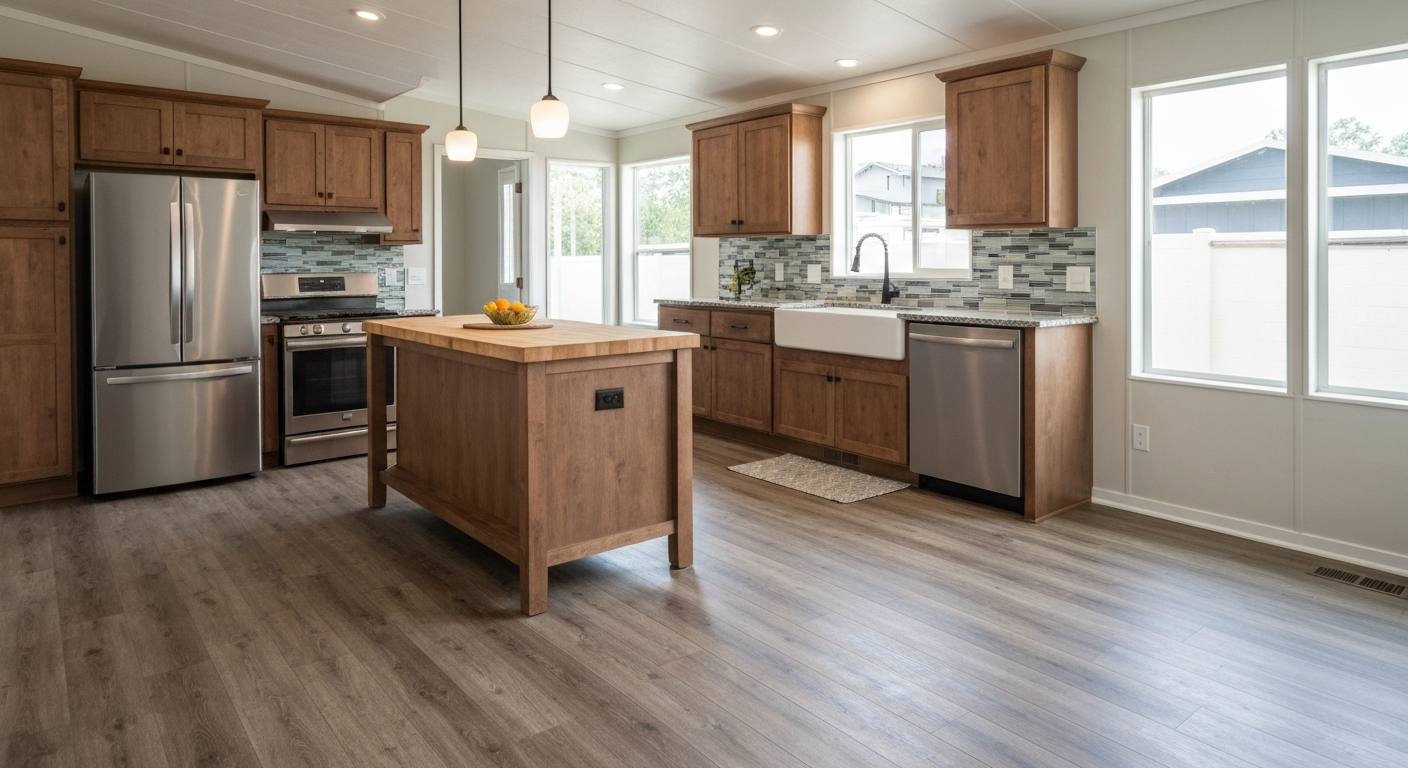
The kitchen is the highest-impact room in any home remodel, and manufactured home kitchens are no exception. Original kitchens in homes built in the 1980s and 1990s typically feature low-quality laminate cabinets, worn countertops, dated appliances, and linoleum flooring that shows its age.
The decision between cabinet refacing and full cabinet replacement deserves careful thought. Manufactured home cabinets are built to non-standard dimensions in many cases, which means standard residential replacement cabinets may not fit without modification. Cabinet refacing, which involves replacing door and drawer fronts while keeping the original cabinet boxes, delivers a high-impact visual transformation at roughly 40-60% of the cost of full replacement.
Countertop replacement is one of the highest-return updates available. Replacing original laminate countertops with butcher block, laminate in a modern pattern, or quartz transforms the visual quality of the kitchen significantly. For manufactured homes, the countertop connection to the wall and the integration with the sink cutout should be done carefully to maintain the moisture seal.
| Kitchen Update | Typical Cost | Impact Level | Notes |
|---|---|---|---|
| Cabinet door and drawer refacing | $1,500 - $5,000 | High visual | Non-standard sizes may add cost |
| Full cabinet replacement | $5,000 - $18,000 | Very high | Measure carefully before ordering |
| Countertop replacement | $800 - $4,500 | High | Butcher block is cost-effective and popular |
| Appliance replacement | $2,000 - $7,000 | High functional | Builder-grade appliances are adequate |
| Sink and faucet replacement | $300 - $900 | Moderate | Check for polybutylene supply lines |
| Lighting update | $200 - $600 | Moderate | Under-cabinet lighting adds warmth |
| Flooring (kitchen only) | $600 - $2,000 | High | Waterproof LVP recommended |
Bathrooms
Bathrooms in older manufactured homes present specific challenges. The original tub and shower surrounds are typically one-piece or multi-piece fiberglass or acrylic units bonded to the wall. Removing them almost always reveals water damage behind, and the wall material behind original bathroom fixtures in manufactured homes is typically not cement board or tile backer. It is drywall or thin paneling that degrades quickly with moisture exposure.
A thorough bathroom renovation in a manufactured home should include inspection and replacement of all wall material behind the original shower and tub surround with cement board or a comparable moisture-resistant product before installing the new surround or tile. Cutting this corner is the most common cause of recurring moisture problems in remodeled manufactured home bathrooms.
| Bathroom Update | Typical Cost | Key Consideration |
|---|---|---|
| Tub and surround replacement | $1,500 - $5,000 | Inspect and replace wall material behind |
| Toilet replacement | $300 - $800 | Check subfloor at base before seating new unit |
| Vanity and sink replacement | $400 - $1,800 | Measure existing space carefully |
| Flooring replacement | $400 - $1,200 | Inspect subfloor first |
| Complete bathroom renovation | $4,000 - $12,000 | Budget for wall material replacement |
Exterior
The exterior of a manufactured home has a significant impact on curb appeal and market value, and it is also the primary line of defense against moisture intrusion. Deteriorated siding, damaged skirting, a failing original roof, and inadequate drainage around the perimeter all create pathways for water to reach the structural components of the home.
Skirting, the material that encloses the space between the bottom of the manufactured home and the ground, is often overlooked in remodeling plans. Deteriorated skirting creates pathways for cold air, moisture, and pests to enter the belly board area and the floor system. Replacing skirting with insulated vinyl or concrete block creates a meaningful improvement in both energy performance and structural protection.
| Exterior Update | Typical Cost | Key Benefit |
|---|---|---|
| Vinyl siding replacement | $5,000 - $14,000 | Weatherproofing and curb appeal |
| Skirting replacement | $800 - $3,000 | Energy performance and moisture protection |
| Roof-over installation | $6,000 - $15,000 | Weatherproofing and visual transformation |
| Entry door replacement | $600 - $2,000 | Security, weatherproofing, visual impact |
| Window replacement | $3,000 - $10,000 | Energy performance and appearance |
| Deck or porch addition | $3,000 - $15,000+ | Livability and curb appeal |
The Moisture Management Imperative
If there is a single theme that runs through every aspect of manufactured home remodeling, it is moisture management. Manufactured homes are more vulnerable to moisture damage than site-built homes in several ways, and every remodeling decision should be evaluated through the lens of how it affects the home's ability to manage moisture.
The floor system, built on a steel chassis close to the ground, is exposed to ground moisture from below. The belly board, a layer of material that encases the underside of the floor system, is the primary barrier against ground moisture. When the belly board is damaged, torn, or absent, moisture reaches the floor joists and subfloor, accelerating deterioration.
The practical implications for remodeling are consistent. Any flooring project should begin with a moisture assessment of the subfloor. Any bathroom renovation should include proper moisture-resistant wall materials behind all wet areas. Any roof work should address flashing and sealant at every penetration point. And proper skirting with ventilation is essential for managing ground moisture in the belly board area.
MOISTURE RISK ASSESSMENT BY LOCATION
(Priority level for inspection before remodeling)

Location                 Risk Level     Primary Concern
------------------------------------------------------
Under kitchen sink        Very High      Supply line leaks, drain condensation
Bathroom subfloor         Very High      Long-term humidity, toilet seal failure
Around tub and shower     Very High      Surround seal failure, splash infiltration
Belly board               High           Ground moisture, damaged insulation
Roof penetrations         High           Sealant failure, standing water
Window perimeters         Moderate       Failed glazing compound, exterior caulk
Exterior wall base        Moderate       Siding-to-foundation gap, splash-back
Living area subfloor      Low-moderate   Seasonal humidity, HVAC condensate
Addressing moisture sources before investing in cosmetic improvements is the discipline that separates manufactured home renovations that hold up over time from renovations that require repeat investment.
Split Level Home Remodel: A Different Category Worth Noting
Split level homes are site-built homes, not manufactured homes, and they come with their own set of remodeling considerations. Because the search term appears frequently alongside manufactured home remodeling questions, a brief orientation is useful.
A split level home is a site-built home in which the floor levels are offset by partial stories, typically with the main living area on one level, bedrooms a half-story up, and a lower level containing a garage or family room a half-story down. They were popular in American residential construction from the 1950s through the 1980s.
The most common split level remodel projects involve opening up the interior by removing or modifying the partial walls and level transitions that can make these homes feel choppy and dark, updating kitchens and baths that reflect their era of construction, improving natural light through window additions or skylights, and modernizing the exterior appearance with updated siding, rooflines, and landscaping.
Split level remodeling requires careful attention to structural walls, since the offset floor system means load paths are more complex than in a single-story or simple two-story home. Any wall removal in a split level home should be evaluated by a structural engineer before work begins, as noted in our home design and planning guide.
The table below outlines the most common split level remodel projects and their approximate costs:
| Project | Typical Cost Range | Key Consideration |
|---|---|---|
| Kitchen renovation | $15,000 - $50,000 | Often connected to living area, impacts flow |
| Bathroom renovation | $8,000 - $25,000 | Plumbing access can be complex in split levels |
| Opening walls or levels | $5,000 - $20,000+ | Structural engineering review required |
| Window additions | $2,000 - $8,000 per window | Structural review for new openings |
| Exterior siding and facelift | $12,000 - $35,000 | Major visual impact |
| Lower level finishing | $20,000 - $50,000 | Moisture management is critical |
| Staircase update | $3,000 - $12,000 | High visual impact, relatively contained |
Finding the Right Contractor for a Manufactured Home Remodel
Finding a contractor with genuine manufactured home remodeling experience is one of the most important and most underestimated parts of a successful manufactured home renovation. Many general contractors who do excellent work on site-built homes have limited experience with the specific structural, plumbing, and electrical characteristics of manufactured homes.
A contractor unfamiliar with manufactured home construction may install flooring over a damaged subfloor without addressing the underlying moisture issue, use standard residential framing techniques in areas where HUD Code requires different specifications, or miss the signs of aluminum wiring that require specific handling.
Questions to ask any contractor before hiring them for a manufactured home remodel:
How many manufactured home remodeling projects have you completed in the last two years? What is your experience with HUD Code compliance for structural changes? How do you handle subfloor damage when you find it under existing flooring? Are you familiar with the difference between aluminum and copper wiring in manufactured homes? Can you provide references from manufactured home remodeling projects specifically?
The table below outlines the key contractor verification steps for a manufactured home remodel:
| Verification Item | Why It Matters for Manufactured Homes | How to Check |
|---|---|---|
| Manufactured home experience | Structural characteristics differ from site-built | Ask for specific project references |
| HUD Code familiarity | Required for structural changes and additions | Ask directly during initial consultation |
| Subfloor assessment practice | Moisture damage is common and often hidden | Ask about their standard inspection process |
| License and insurance | Same as any contractor | State licensing board, certificates of insurance |
| Aluminum wiring knowledge | Common in pre-1990 homes, requires specific handling | Ask directly |
| Hazmat awareness | Pre-1978 homes may have lead paint | Ask about their testing and handling procedures |
A contractor who is unfamiliar with these questions is probably not the right choice for the project. Read more on how to choose a home builder or contractor.
Planning Your Remodel in Phases: A Practical Roadmap
Most manufactured home owners cannot complete a full renovation in one project. Costs are real, and life does not pause for construction. Planning a phased remodel allows you to make meaningful progress over time without overextending the budget or living in a construction zone indefinitely.
The framework below organizes manufactured home remodel work into three logical phases that build on each other:
Phase One: Foundation and Protection
This phase addresses everything that protects the home from further deterioration. It is the least glamorous phase and the most important. Work done in Phase One makes every subsequent investment more durable and more valuable.
Phase One includes subfloor inspection and repair, moisture barrier and skirting repair or replacement, roof assessment and any necessary repair or roof-over, plumbing inspection and polybutylene replacement if present, electrical inspection and any necessary panel or aluminum wiring updates, and exterior sealant at all penetrations, windows, and doors.
The logic is straightforward. Installing new flooring over a damaged subfloor is money wasted. Investing in a kitchen renovation while the roof leaks is a losing proposition. Phase One creates the stable foundation on which everything else builds.
Phase Two: Systems and Major Rooms
Phase Two addresses the rooms and systems that have the greatest impact on daily livability and market value. Kitchen renovation or update, bathroom renovation, insulation upgrade, window replacement if not addressed in Phase One, and HVAC system update if the original system is aging or undersized.
Phase Two is where the home begins to feel genuinely transformed. The combination of an updated kitchen, renovated bathroom, new windows, and improved insulation changes the daily experience of the home substantially.
Phase Three: Cosmetic and Curb Appeal
Phase Three delivers the visual transformation that makes the home feel complete. New flooring throughout if not addressed in Phase One, interior paint, updated lighting and fixtures, exterior siding replacement, landscaping and driveway updates, deck or porch addition, and any remaining cosmetic details.
Phase Three work tends to be the most satisfying because the results are immediately visible, but it delivers the best return when the foundation has been properly addressed in Phase One and Two.
PHASED REMODEL TIMELINE AND BUDGET FRAMEWORK
(Approximate, based on 1,200-1,400 sq ft manufactured home)

Phase        Focus                          Timeline    Budget Range
--------------------------------------------------------------------
Phase One    Protection and structure       2-4 months  $8,000 - $22,000
Phase Two    Systems and major rooms        3-6 months  $18,000 - $45,000
Phase Three  Cosmetic and curb appeal       2-4 months  $10,000 - $25,000
--------------------------------------------------------------------
Total range across all three phases:                   $36,000 - $92,000

Note: Phases can overlap where scope permits.
Phase One should always precede cosmetic investment.
The phased approach also has a financing advantage. Completing Phase One, which addresses structural and protection issues, may increase the appraised value of the home enough to unlock equity financing for Phase Two. Each phase builds on the previous one, both structurally and financially.
Working with a realistic timeline:
Most homeowners underestimate how long a phased manufactured home remodel takes from start to finish. Contractor scheduling, permit timelines, material lead times, and the reality of living in the home during construction all extend timelines beyond initial expectations. Planning for each phase to take 25-50% longer than the initial estimate keeps expectations realistic and reduces stress when the inevitable delays occur.
The owners who complete successful manufactured home remodels are the ones who started with a realistic assessment of the home's condition, built a phased plan that prioritized protection over cosmetics, found a contractor with genuine manufactured home experience, kept a meaningful contingency reserve, and stayed patient through the process.
The result, a manufactured home that has been thoughtfully renovated from the subfloor up, is a genuinely livable, durable, and valuable home that bears little resemblance to the aging structure where the project began.
Key Takeaways
A manufactured home remodel, approached with the right planning, the right contractor, and a clear sense of priorities, can deliver a dramatically improved living environment and meaningful increases in market value. The homes are worth investing in, and the remodeling process is well within reach for most homeowners with a realistic budget and a clear scope of work.
The most important principles for a successful manufactured home remodel are these. Inspect the subfloor before committing to any flooring project. Understand the real property versus personal property distinction before approaching lenders. Find a contractor with specific manufactured home experience. Separate the structural and systems work from the cosmetic work, and invest in the structural work first. Budget a minimum 15% contingency for a home type where surprises are common.
The path from an aging manufactured home to a comfortable, updated, efficient living space is well-traveled. The owners who get there successfully are the ones who planned carefully before the first tool came out.
Frequently Asked Questions
What is the difference between a manufactured home and a mobile home? The term mobile home technically refers to factory-built homes constructed before June 15, 1976. Manufactured homes are factory-built homes constructed after that date to HUD Code federal standards. The distinction matters for remodeling because pre-1976 homes may contain hazardous materials, have no uniform structural standard, and face more restrictions from lenders and insurers.
What is the first thing to address in a manufactured home remodel? Before any cosmetic work, inspect the subfloor for moisture damage and soft spots, particularly under the kitchen and bathrooms. Addressing subfloor damage before installing new flooring is essential. Installing new flooring over a compromised subfloor is one of the most common and expensive mistakes in manufactured home remodeling.
Can you get a home equity loan to remodel a manufactured home? Yes, in many cases. Manufactured homeowners who own their land and have had their home titled as real property can access home equity loans and HELOCs on terms similar to site-built homes. Homes on leased land or titled as personal property have fewer options, but the FHA Title I loan program is specifically designed for manufactured home improvements and does not require equity.
What remodel projects add the most value to a manufactured home? Flooring replacement with luxury vinyl plank, subfloor repair, kitchen updates, bathroom renovation, and roof-over installation consistently deliver the best combination of livability improvement and market value return. Exterior improvements including siding replacement and updated landscaping have high visual impact and meaningful market value benefit.
Do manufactured home remodels require permits? Yes, for structural changes, additions, and major systems work. Any change to the structure, electrical system, plumbing, or HVAC in a manufactured home requires permits and inspections in most jurisdictions, just as it would in a site-built home. HUD Code compliance applies to structural changes. Always check with your local building department before beginning significant remodel work.
What should I look for when hiring a contractor for a manufactured home remodel? Look for a contractor with specific manufactured home remodeling experience, not just general residential remodeling experience. Ask for references from manufactured home projects. Ask about their familiarity with HUD Code, subfloor inspection practices, aluminum wiring handling, and hazardous materials procedures. A contractor who can speak to these topics with confidence is far more likely to deliver a successful result.
Are there tax credits available for manufactured home renovations? Certain energy-efficiency improvements to a manufactured home used as a primary residence may qualify for federal tax credits. The Energy Efficient Home Improvement Credit covers insulation, windows, doors, and certain HVAC upgrades. The Residential Clean Energy Credit covers solar and battery storage systems. Consult a tax professional about eligibility for your specific project and circumstances.