Quick answer: Bucknell West Campus Housing in Lewisburg, Pennsylvania used 76 volumetric modules to deliver approximately 125,000 square feet of student housing in 213 days. Building modules in a factory while crews prepared the site let the two workstreams overlap, which is the main reason modular compressed the schedule. Modular is not always cheaper, but faster occupancy and less campus disruption are often the bigger financial benefit.
Project Snapshot
| Project Detail | Information |
|---|---|
| Project Name | Bucknell West Campus Housing |
| Location | Lewisburg, Pennsylvania |
| Building Type | Education / Student Housing |
| Project Size | Approximately 125,000 sq ft |
| Construction Method | Volumetric Modular Construction |
| Module Count | 76 volumetric modules |
| Timeline | 213 days |
| General Contractor | Benchmark Construction |
| Modular Manufacturer | Simplex Homes |
| Primary Use | Student housing |
| Main Construction Advantage | Faster delivery through factory and site work overlap |
Why Bucknell West Campus Housing Matters
Student housing is one of the strongest use cases for modular construction.
The reason is repeatability. Dorm rooms, bathrooms, corridors, mechanical chases, and common layouts often follow a repeated design pattern. That repetition makes factory-built construction more efficient because the manufacturer can standardize framing, finishes, MEP coordination, inspections, and assembly workflows.
For universities, the benefit goes beyond construction speed.
A campus is not a vacant job site. It is a live environment with students, faculty, staff, visitors, athletic events, maintenance teams, parking pressure, and safety requirements. A long construction schedule can affect daily operations. Noise, dust, truck traffic, fenced-off walkways, and weather delays can create months of disruption.
The Bucknell West Campus Housing project shows how modular construction can reduce that disruption by shifting a large part of the work away from the site and into a controlled factory environment.
Instead of building the entire structure piece by piece on campus, the project used factory-built volumetric modules. These modules could be fabricated while the site team worked on foundations, utilities, access logistics, and preparation. This overlap is one of the central advantages of modular construction.
In traditional construction, many activities happen in sequence. In modular construction, several major activities can happen at the same time.
That changes the project schedule.
What Is Volumetric Modular Construction?
Volumetric modular construction is a building method where three-dimensional sections of a building are manufactured off-site in a factory and then transported to the project location for final assembly.
These modules are not simple panels. They are room-sized or multi-room building sections. Depending on the project, they may include framing, insulation, windows, drywall, flooring, bathrooms, plumbing, electrical rough-ins, HVAC components, cabinetry, fixtures, finishes, and other systems. (For more on how integrated systems are changing, check out our report on building smarter technology).
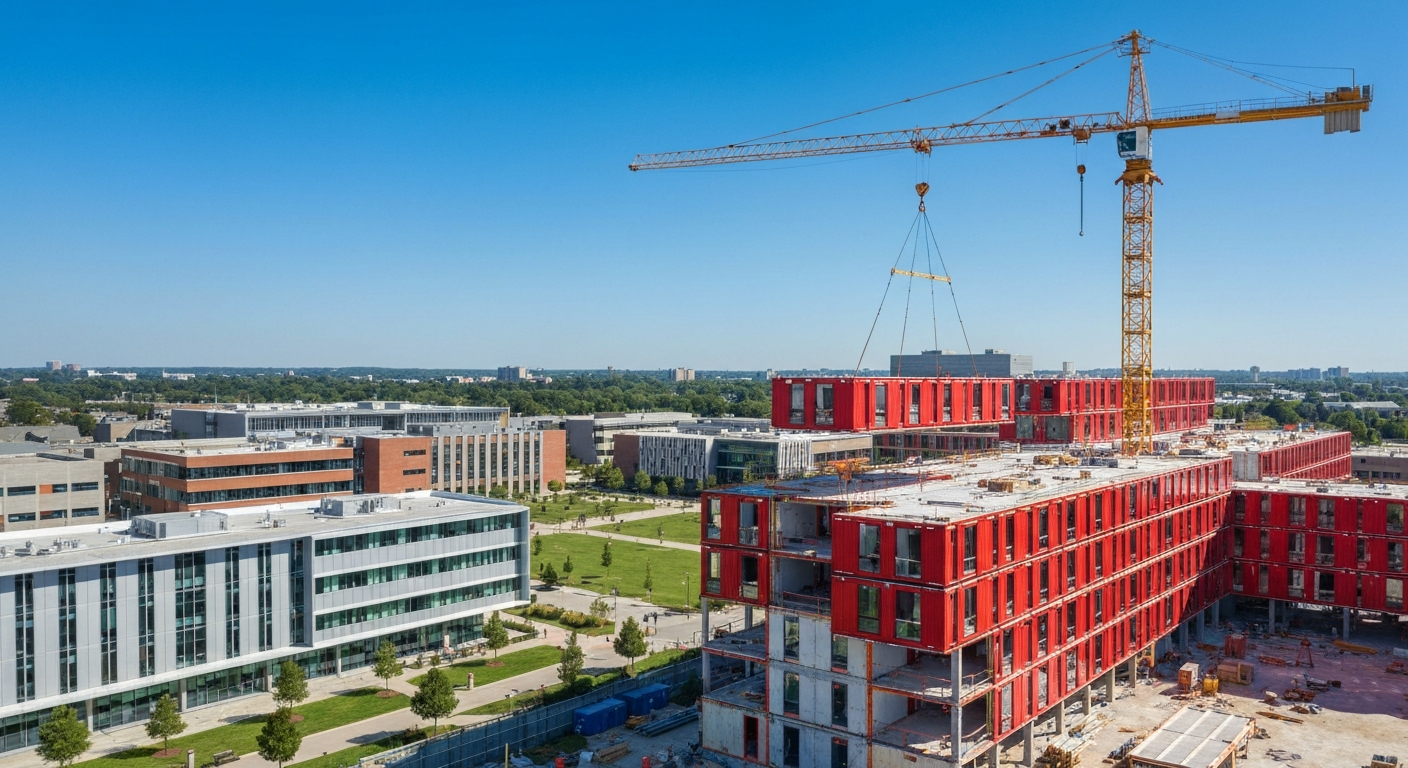
Once the modules arrive on-site, cranes lift them into place. Crews then connect the modules structurally and mechanically, complete exterior work, finish site-built elements, and finalize inspections.
Volumetric Modular vs. Panelized Construction
Volumetric modular construction is different from panelized construction.
Panelized construction uses factory-built wall panels, floor panels, or roof panels that are assembled on-site. Volumetric modular construction goes further. It delivers three-dimensional building sections that already contain a large portion of the finished space. Regional codes and innovative materials also shape what is buildable; see our look at Texas construction compliance and innovative materials.
For student housing, this matters because bedrooms and bathrooms can be repeated across the project. The more repeatable the layout, the more value modular construction can provide.
The Challenge: Campus Expansion Under a Tight Timeline
Bucknell University needed additional student housing on its West Campus. Like many universities, the project faced several constraints:
- The academic calendar created a fixed deadline.
- Campus disruption needed to be minimized.
- Pennsylvania weather could create seasonal risk.
- Traditional construction could stretch across multiple academic periods.
- Student housing required consistency, durability, and reliable acoustic performance.
- The project needed coordination between design, manufacturing, logistics, site work, and final assembly.
Traditional stick-built construction can handle these projects, but it often requires a longer schedule. Weather delays, labor availability, material sequencing, inspection timing, and site congestion can slow progress.
For a campus, delay is expensive. A late housing project can affect student assignments, revenue planning, temporary housing, and campus operations.
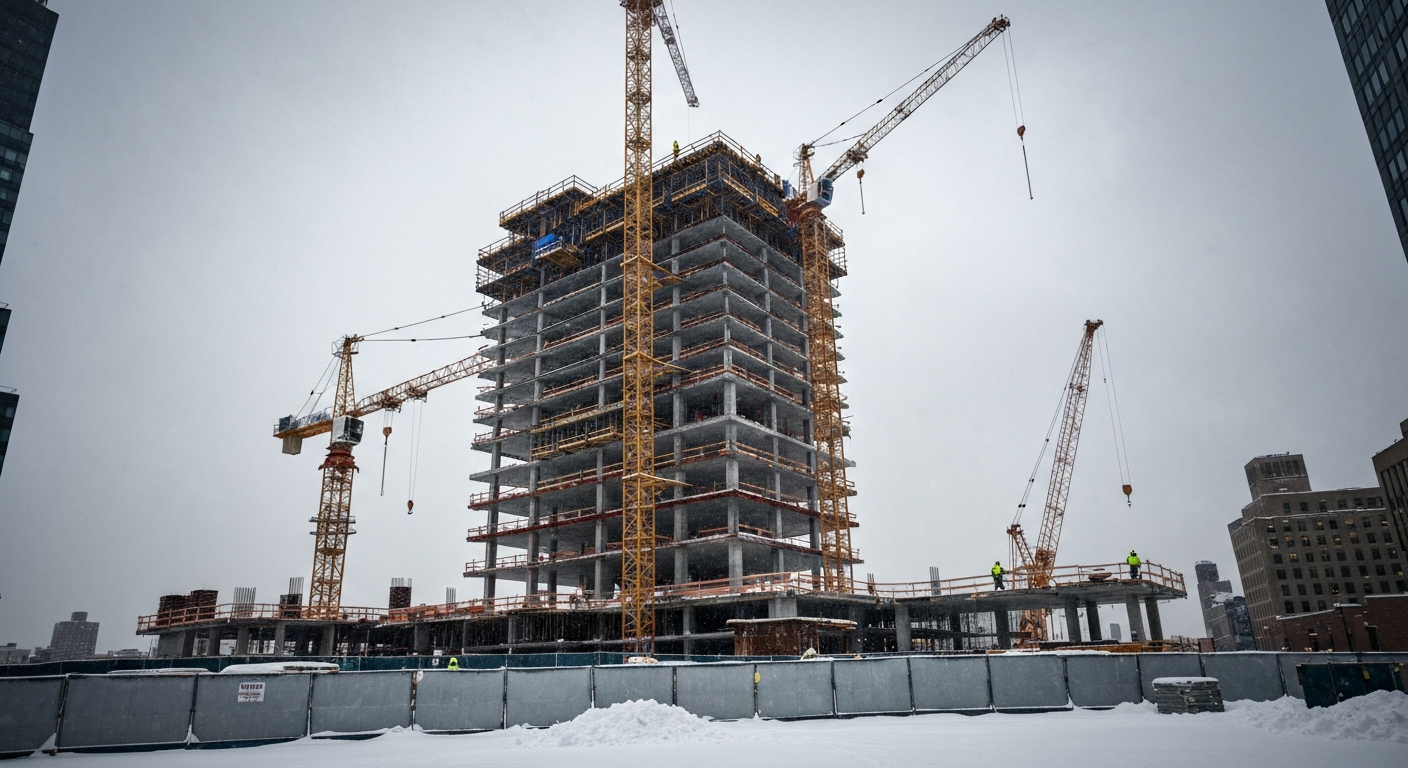
The modular approach helped address these risks by moving a large portion of construction into a factory. While site crews prepared the foundation and utilities, the modular manufacturer could build the units in parallel. Weather is a scheduling risk on any site; see how developers manage it in our extreme weather construction spotlight from New York.
That single scheduling shift is one of the biggest reasons modular construction can shorten delivery timelines.
The Role of DfMA in the Project
One of the most important factors in the Bucknell West Campus Housing project was early design coordination.
The project used Design for Manufacture and Assembly, commonly called DfMA. DfMA is a planning method that designs the building around how it will be manufactured, transported, lifted, connected, and finished.
This is different from designing a traditional building first and then trying to “convert” it into modular later.
That mistake is common. Owners sometimes decide they want modular construction after the design is already too far along. By then, room dimensions, structural grids, corridor layouts, mechanical routes, and façade details may not fit factory production or transportation limits.
Bucknell’s project shows why modular planning needs to begin early. For more on how modern methods and materials are changing home building, see innovating modern home construction in the USA.
Why Early DfMA Matters
DfMA helps answer practical questions before they become expensive problems:
- Can each module fit transportation limits?
- Where will structural mate-lines occur?
- How will corridors align with module edges?
- Where will plumbing stacks and mechanical systems connect?
- Can finishes be installed in the factory without damage during transport?
- How will the crane access the site?
- What tolerances are required for the foundation?
- How will inspectors review factory-built and site-built work?
- Which details must be completed in the factory and which must be completed on-site?
These questions are not small details. They shape the entire project.
In Bucknell’s case, the design team coordinated module layout, corridor alignment, MEP routing, and assembly logic early enough to make modular construction practical.
Design Strategy: Making Modular Feel Permanent
A common concern about modular student housing is perception. Owners do not want buildings that feel temporary, cheap, or visually disconnected from the campus.
The Bucknell West Campus Housing project needed to feel like a permanent part of the university environment. That meant the modular system had to support architectural quality, durability, acoustic comfort, and student experience.
Hiding the Module Lines
One design strategy involved integrating corridors with module mate-lines. A mate-line is the location where two modular units meet. If poorly planned, mate-lines can create awkward seams, uneven transitions, or visual interruptions.
By aligning corridors and structural seams carefully, the design could hide or reduce the visibility of module connections. This made the finished building feel more unified.
Improving Acoustic Performance
Student housing requires strong acoustic separation. Noise from neighboring rooms, corridors, bathrooms, and common areas can affect student comfort.
Modular construction can offer an advantage because modules often include double-wall conditions between units. When designed correctly, this can improve sound separation compared with some traditional assemblies.
For campus housing, this is not just a technical benefit. It affects the daily experience of students living in the building.
Coordinating MEP Systems
Mechanical, electrical, and plumbing systems are among the most coordination-heavy parts of any building. In modular construction, MEP coordination must be especially precise because many components are installed before the modules arrive on-site.
The Bucknell project used a high level of factory-installed MEP work. This helped reduce field labor, improve quality control, and speed up final assembly.
Construction Approach: Factory Meets Field
The Bucknell West Campus Housing project can be understood through three main construction phases:
- Site preparation and foundation work
- Factory fabrication
- Delivery, craning, and final assembly
The power of modular construction comes from the overlap between these phases.
Phase 1: Site Preparation and Foundation
While the modular units were being manufactured off-site, crews on campus could prepare the site.
This likely included:
- Clearing and grading
- Utility coordination
- Foundation layout
- Concrete work
- Access planning
- Crane logistics
- Delivery staging
- Safety planning
- Inspection coordination
In traditional construction, much of the building work begins only after the foundation is ready. In modular construction, the building modules can be produced while foundation work is still underway.
That parallel schedule can save weeks or months.
Foundation Tolerance Is Critical
Modular construction requires accurate foundations. If a site-built foundation is out of tolerance, modules may not align properly. This can cause problems with structural connections, corridor alignment, MEP connections, exterior finishes, and interior transitions.
For a 76-module project, tolerance control is not optional. It is one of the most important success factors.
A small dimensional error can multiply across the building.
That is why modular projects need close coordination between the survey team, foundation contractor, general contractor, modular manufacturer, and design team.
Phase 2: Factory Fabrication
The modular units were built in a factory environment.
This is one of the most important advantages of modular construction. A factory creates a more controlled setting than an open job site.
Benefits of Factory Construction
Factory construction can improve:
- Weather protection
- Worker productivity
- Material storage
- Quality control
- Safety
- Waste reduction
- Repetition
- Inspection consistency
- Schedule predictability
For student housing, factory production is especially useful because many rooms and systems repeat. Once the production line is set up, crews can complete similar assemblies with consistent methods.
Quality Control at Each Stage
In a modular factory, inspections can happen at multiple stages. Framing, insulation, MEP rough-ins, drywall, fixtures, finishes, and final checks can be reviewed before the module leaves the facility.
This staged inspection process can reduce rework on-site.
For owners, that matters because field rework can delay occupancy and increase costs.
Phase 3: Transportation, Craning, and Assembly
After fabrication, the 76 modules were transported to the site and lifted into place.
This is the most visible phase of modular construction. It is also one of the most logistics-heavy.
Transportation Planning
Moving large volumetric modules requires careful route planning. Depending on module size and road conditions, the team may need to coordinate:
- Oversized load permits
- State transportation requirements
- Bridge clearances
- Turning radii
- Utility conflicts
- Delivery windows
- Escorts
- Staging areas
- Weather conditions
- Campus traffic restrictions
For a university campus, logistics are even more sensitive. Deliveries must avoid high-traffic student periods, pedestrian routes, parking conflicts, and campus events.
Crane Assembly
Once on-site, modules are lifted by crane and placed onto the prepared foundation or structural system.
In many modular projects, the building becomes weather-protected much faster than in traditional construction. This is often called being “dried in.” A faster dry-in reduces exposure to rain, snow, wind, and moisture damage.
For Pennsylvania construction, where winter weather can affect schedules, this is a meaningful advantage.
Timeline Comparison: Modular vs. Traditional Construction
The Bucknell West Campus Housing project was completed in 213 days. For student housing, that kind of timeline can create major value.
| Factor | Traditional Stick-Built Construction | Volumetric Modular Construction |
|---|---|---|
| Typical sequencing | Mostly linear | Parallel site and factory work |
| Weather exposure | High | Lower |
| Site disruption | Longer | Shorter |
| Labor concentration | Mostly on-site | Split between factory and site |
| Quality control | Field-based | Factory and field-based |
| Schedule risk | Higher in bad weather | Lower due to off-site fabrication |
| Campus impact | Longer disruption | Reduced disruption |
| Best fit | Custom, one-off projects | Repeatable layouts and tight schedules |
This does not mean modular is always better. It means modular can be better when the project type, design process, logistics, budget, and schedule align.
Student housing is one of those strong-fit categories.
Cost Considerations for Modular Student Housing
Modular construction is often marketed as cheaper than traditional construction. That is not always accurate.
The better way to think about modular construction is this:
Modular construction can reduce total project risk and shorten delivery time, but it does not automatically reduce every line item.
For some projects, modular can lower costs. For others, the direct construction cost may be similar to traditional methods. The financial advantage may come from earlier occupancy, reduced disruption, less weather delay, fewer change orders, less waste, and more predictable scheduling.
Cost Factors That Matter
Several factors affect modular construction cost:
- Project size
- Distance from factory to site
- Module size
- Transportation permits
- Crane requirements
- Finish level
- MEP complexity
- Foundation design
- Local labor rates
- Inspection requirements
- Façade system
- Site constraints
- Repetition of room layouts
- Early design coordination
For Bucknell, the value was not just in building faster. The value came from combining schedule compression, factory coordination, repeatable units, reduced site disruption, and a more predictable delivery path.
Why Student Housing Is a Strong Fit for Modular Construction
Student housing often has the exact conditions modular construction needs to perform well.
Repeatable Room Layouts
Dormitories and residence halls often use repeated bedroom, bathroom, and corridor layouts. Repetition allows factory teams to refine production and reduce variation.
Fixed Occupancy Dates
Universities operate on academic calendars. A student housing project usually needs to open before a semester begins. Missing that date can create serious operational and financial problems.
Limited Campus Space
Campus job sites often have tight access, limited staging, and heavy pedestrian movement. Reducing on-site construction duration helps protect campus operations.
High Demand for Predictability
Universities need predictable budgets and timelines. Modular construction can reduce some forms of uncertainty, especially weather-related delays and labor availability issues.
Quality Expectations
Student housing must be durable. Factory-built construction can support consistent quality when design, inspection, and manufacturing controls are strong.
Lessons Learned from Bucknell West Campus Housing
The Bucknell project offers several lessons for developers, campus planners, general contractors, architects, and modular manufacturers.
Lesson 1: Modular Must Start Early
The most successful modular projects begin with modular thinking during the earliest planning stages.
Owners should not wait until late design development to ask whether a project can be modular. By then, the building may already be shaped around assumptions that make modular construction harder or more expensive.
Best Practice
Bring the modular manufacturer, general contractor, architect, structural engineer, and MEP team into the conversation early.
Lesson 2: The Design Must Match the Manufacturing Process
A modular building is not just a traditional building built somewhere else. It is a building designed for manufacturing, transportation, lifting, stacking, joining, and finishing.
That means design decisions should consider:
- Module dimensions
- Structural loads
- Shipping limits
- Crane picks
- Mate-lines
- Corridor alignment
- Utility connections
- Fire ratings
- Acoustic separation
- Exterior envelope transitions
When these items are planned early, the final building can feel seamless.
Lesson 3: Transportation Can Make or Break the Schedule
Transportation is one of the most underestimated parts of modular construction.
A 76-module project requires serious logistics. Each module must arrive in the right order, at the right time, with the right permits, and with enough staging space for safe installation.
Route planning should begin months before delivery.
Lesson 4: Foundation Accuracy Is Non-Negotiable
Modular projects rely on precision. A foundation that is slightly out of alignment can create major problems during assembly. Foundation and framing decisions also drive cost in site-built homes; see seven structural design decisions that affect cost.
Surveying, layout, concrete placement, and inspection must be held to tight standards.
This is especially important when modules stack vertically or connect across long corridors.
Lesson 5: Factory Quality Control Reduces Field Risk
Factory construction allows repeatable inspection and consistent production. This can reduce errors and limit the amount of work that needs to be fixed after installation.
For projects with many repeated units, this can be a major advantage.
Lesson 6: Modular Reduces Site Disruption
For active campuses, hospitals, hotels, dense urban lots, and multifamily developments, reducing site disruption can be worth as much as reducing direct construction cost.
Less time on-site can mean:
- Less noise
- Less dust
- Less truck traffic
- Fewer safety conflicts
- Fewer blocked walkways
- Reduced impact on daily operations
For Bucknell, that benefit was central.
Frequently Asked Questions
What is volumetric modular construction?
Volumetric modular construction is a building method where three-dimensional sections of a building are built in a factory and then transported to the project site for final assembly. These modules may include framing, drywall, windows, bathrooms, MEP systems, fixtures, and finishes before they arrive on-site.
How many modules were used in the Bucknell West Campus Housing project?
The project used 76 volumetric modular units for the West Campus Housing development.
Where is Bucknell West Campus Housing located?
The project is located in Lewisburg, Pennsylvania, on Bucknell University’s campus.
How large is the Bucknell West Campus Housing project?
The project is listed as approximately 125,000 square feet.
How long did the Bucknell modular housing project take?
The project timeline was 213 days, which shows how modular construction can compress schedules when factory fabrication and site preparation happen at the same time.
Why is modular construction useful for student housing?
Student housing often uses repeatable room layouts, bathrooms, corridors, and building systems. That repetition makes it easier to manufacture modules efficiently in a factory. Universities also benefit from shorter site disruption and more predictable occupancy dates.
Is modular construction cheaper than traditional construction?
Not always. Modular construction can reduce some costs and risks, but savings depend on project size, design, logistics, factory distance, labor rates, and schedule value. In many cases, the biggest financial benefit comes from faster occupancy and lower disruption rather than lower direct construction cost.
What is DfMA?
DfMA means Design for Manufacture and Assembly. It is a design approach that plans a building around how it will be manufactured, transported, assembled, and finished. DfMA is important for modular construction because decisions about module size, structure, utilities, and transportation must happen early.
What types of buildings are best for modular construction?
Strong candidates include student housing, hotels, multifamily housing, workforce housing, healthcare facilities, senior housing, and projects with repeatable room layouts.
What is the biggest risk in modular construction?
One of the biggest risks is late coordination. Modular construction requires early decisions. If the owner, architect, contractor, and manufacturer are not aligned early, the project can face design conflicts, transportation issues, MEP problems, and assembly delays.