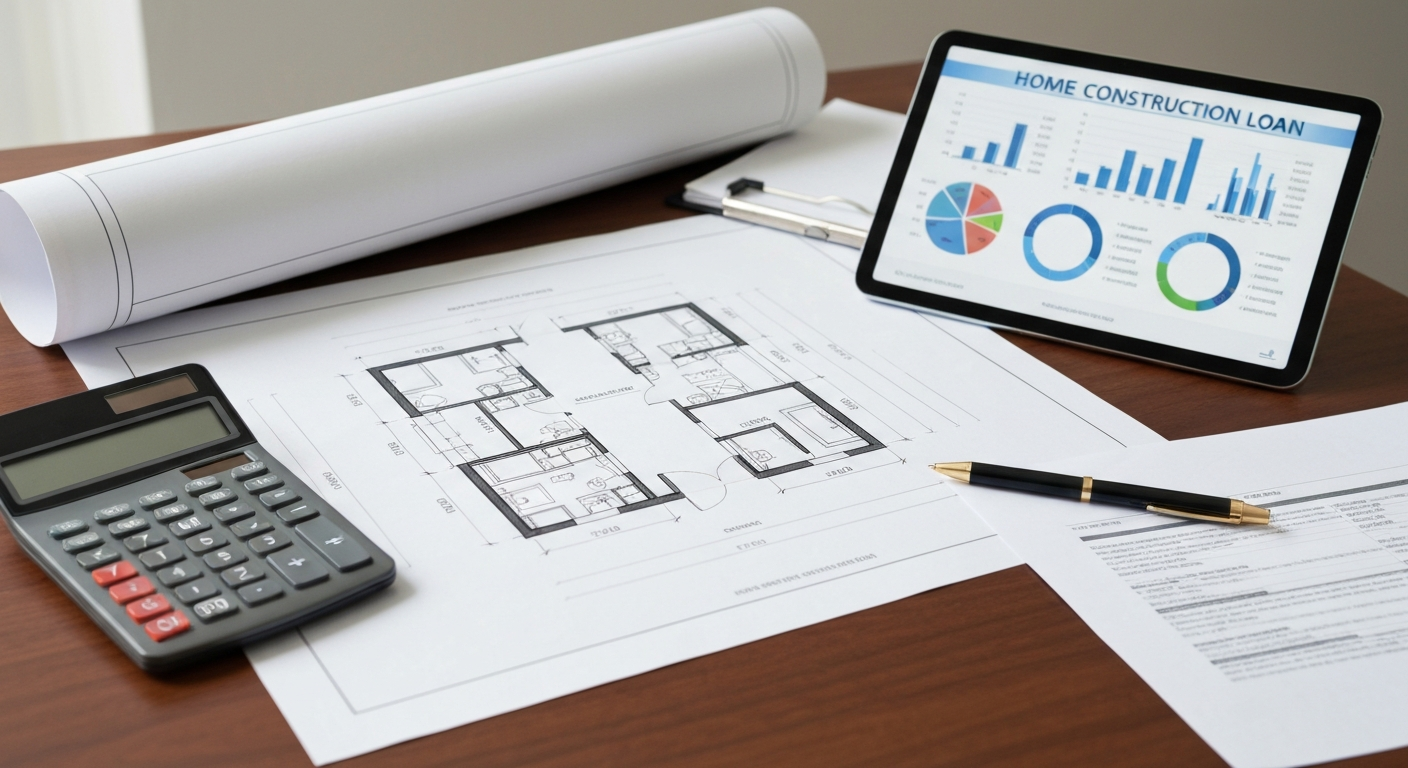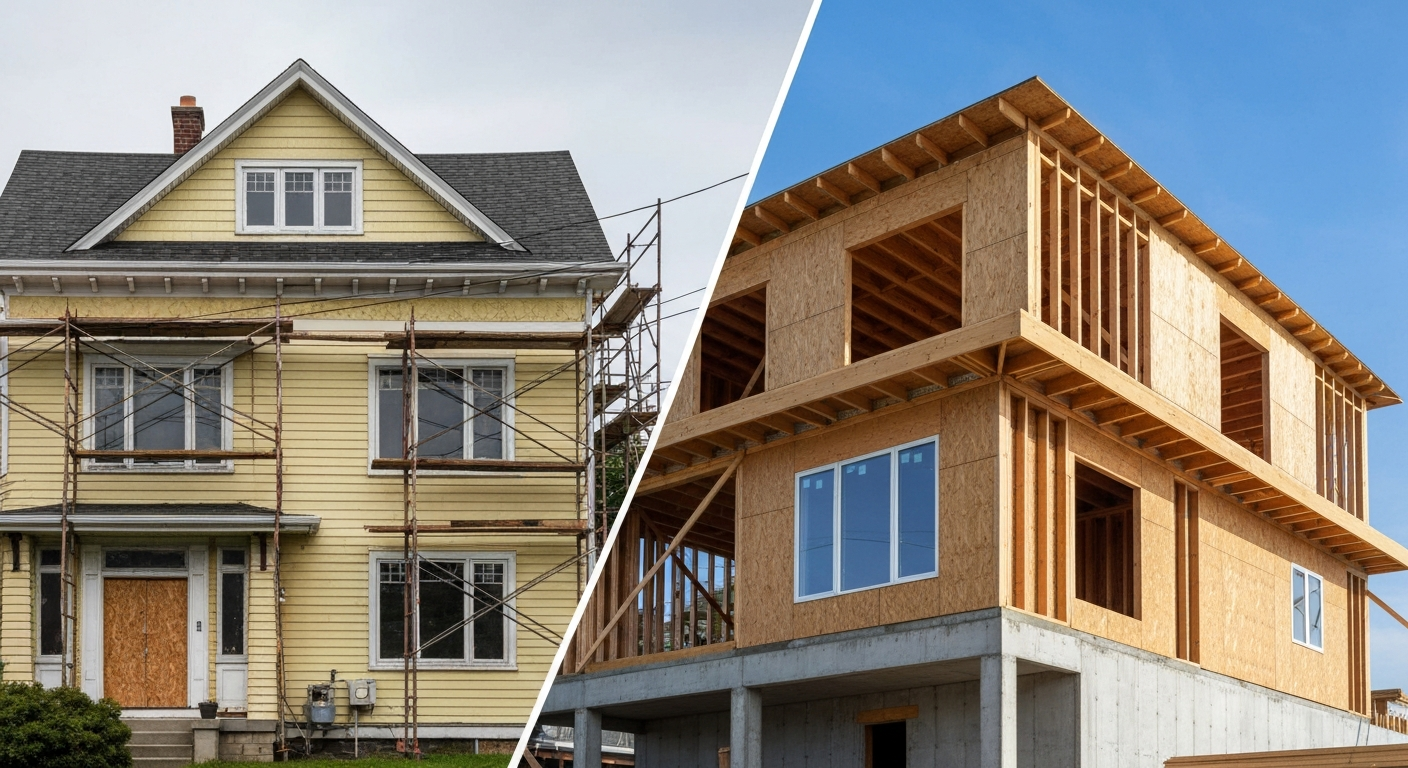

Building a custom home requires more than architectural blueprints; it requires a precise financial roadmap. Unlike a traditional mortgage, where the financial math is a straightforward calculation of purchase price minus down payment, financing a new build involves a moving target. You are paying for a structure that does not yet exist, using funds that are released in phases, with interest that compounds only on the money you have actually spent.
For future homebuilders and real estate investors alike, the confusion usually starts when trying to predict what the monthly payments will actually look like during the construction phase. Because construction loans are typically interest-only during the build period, your first payment might be $200, while your final payment before converting to a permanent mortgage might be $2,500.
This unpredictability is exactly why we built the Construction Loan Calculator. But a calculator is only as good as the assumptions you feed into it. This guide breaks down exactly how construction loan math works, what costs you must include in your baseline, and how to use our tool to structure your financing and avoid cash flow crises mid-build.
For more details, see our home construction loan guide. If you own a home already and are weighing a home equity loan instead, compare the two in home equity loan vs. construction loan.
Quick answer: Construction loan payments start small and grow. You pay interest only on the funds drawn so far, and lenders size the loan using two ratios: loan-to-value (LTV) and loan-to-cost (LTC).
- LTV compares the loan to the appraised value of the completed home; LTC compares it to the total cost to build
- Banks typically fund based on whichever number is lower
- A one-time close loan locks your permanent rate before construction begins; a stand-alone loan adds a second closing (our calculator estimates $4,500)
- Always include a 10% to 15% contingency reserve in your total project cost
The Core Metrics: LTV and LTC Explained
When a bank evaluates your construction loan application, they look at two critical ratios to determine how much they are willing to lend and how much cash you need to bring to the table. Our calculator explicitly models both.
Loan-to-Value (LTV) LTV measures the loan amount against the appraised future value of the completed home. Because the home does not exist yet, the bank orders an "as-completed appraisal" based on your architectural blueprints and comparable homes in the area. If the completed home is appraised at $600,000 and the bank requires an 80% LTV, the maximum they will lend is $480,000.
Loan-to-Cost (LTC) LTC measures the loan amount against the hard cost of construction (land plus building materials, labor, and soft costs). If the total cost to build the home is $500,000 and the bank allows an 80% LTC, they will lend up to $400,000.
Banks will typically fund based on whichever number is lower to protect their downside. In our calculator, you can input your estimated "As-Completed Appraised Value" alongside your build costs to instantly see if your LTV or LTC crosses the high-risk 80% threshold.
The Three Components of Your Total Project Cost
The most common mistake first-time builders make when estimating their loan requirements is focusing entirely on the "hard costs" of the physical structure and ignoring the rest of the development budget. A construction loan is based on the Total Project Cost, which consists of three distinct buckets.
1. Land Costs or Land Equity If you are buying the land simultaneously with the build (a "Buy Land + Build" scenario), the purchase price of the lot is rolled into the total project cost. If you already own the land, its appraised value acts as your equity contribution, which lenders typically count toward your required down payment.
2. Hard Construction Costs These are the tangible costs of building the home. This includes site preparation, foundation, framing, roofing, plumbing, electrical, HVAC, and all interior finishes. When a builder quotes you a "price per square foot," they are usually only quoting hard costs.
3. Soft Costs and Contingency Soft costs include architectural plans, engineering fees, municipal permits, utility tap fees, and builder overhead. Additionally, every responsible lender will require a contingency reserve—typically 10% to 15% of the hard costs—built into the loan to cover unexpected overruns or change orders.
| Cost Category | Typical Percentage of Total | What It Includes |
|---|---|---|
| Land Acquisition | 15% - 25% | Lot purchase, closing costs on land |
| Hard Costs | 55% - 65% | Materials, labor, site work |
| Soft Costs | 8% - 12% | Permits, design fees, utility connections |
| Contingency Reserve | 10% - 15% | Buffer for material price spikes or changes |
If you enter only the hard costs into our loan calculator, you will under-borrow, which often leads to construction coming to a halt when funds dry up before the house is finished.
How the Draw Schedule Drives Your Interest Payments
The defining feature of a construction loan is the draw schedule. The lender does not hand you or your builder a check for $400,000 on day one. Instead, the funds are held in escrow and released in percentages as specific milestones are completed and verified by an independent inspector.
Because you only pay interest on the funds that have been disbursed, your monthly payment starts near zero and grows each month.
Here is how a standard draw schedule typically breaks down, and how it affects your payments:
- Initial Draw (15%): Covers site clearing, grading, and foundation pouring. Your interest payment is minimal.
- Framing & Roof (25%): The house goes under roof. The loan balance jumps significantly, and your monthly interest payment increases.
- Rough-In (MEP) (20%): Plumbing, electrical, and HVAC are installed inside the walls.
- Drywall & Exterior (15%): The building envelope is sealed.
- Interior Finishes (20%): Flooring, cabinets, and fixtures. By this point, you are paying interest on 95% of the total loan amount.
- Final CO (5%): Released when the certificate of occupancy is issued.
When you use our Construction Loan Calculator, you will notice it calculates both an "Initial Interest Pmt (Mo 1)" and a "Final Interest Pmt (Last Mo)." Budgeting for that final, highest payment is critical, as it often overlaps with the rent or mortgage you are paying on your current residence.
Read more about what are the stages of building a house.
Choosing Your Loan Type: OTC vs. Standalone
Your choice of loan structure fundamentally changes your closing costs and your interest rate risk. Our calculator allows you to toggle between these options to see the immediate financial impact.
One-Time Close (C2P) This structure combines the construction loan and the permanent 30-year mortgage into a single transaction. You close once, pay one set of closing costs, and your permanent interest rate is locked before construction even begins. When the home is finished, the loan automatically converts to an amortizing mortgage. This is the preferred route for most custom home builders because it eliminates the risk of interest rates rising during the 12-month build period.
Two-Time Close (Standalone) This is a short-term loan strictly for the build phase. When the home is finished, you must apply for a brand new permanent mortgage to pay off the construction loan. You pay closing costs twice, and you are subject to whatever the prevailing mortgage rates are when the home is completed. The advantage is flexibility—if you plan to pay off the loan with the sale of another property immediately after completion, a standalone loan makes sense. In our calculator, selecting a Standalone loan automatically adds an estimated $4,500 in second closing costs to your total budget.
Owner-Builder Loans If you plan to act as your own general contractor, lenders view the project as significantly higher risk. They will require proof of experience and typically charge a premium on the interest rate. Selecting this option in our calculator automatically applies a 15% penalty to both construction and permanent rates to reflect market realities.
The Overlapping Housing Cost Trap
According to industry data, the majority of construction stress stems from predictable financial missteps. The most common is failing to budget for overlapping housing costs.
While your new home is being built, you still need a place to live. Many first-time builders fail to adequately budget for paying rent (or their current mortgage) simultaneously with the rising interest-only payments on the construction loan.
Use the "Payment Progression" chart in our calculator to visualize exactly when your construction interest payments will peak. If your build takes 10 months, months 8, 9, and 10 will be your highest cash-outflow months. You must ensure your liquid reserves can cover your current living expenses plus that peak construction interest payment.
Learn more about what to know before buying land to build a house.
Key Takeaways
Predicting the cost of a construction loan requires more than just knowing your interest rate. It requires an accurate total project budget, a realistic timeline, and an understanding of how the draw schedule compounds your interest over time.
Always include a 10% to 15% contingency reserve in your total project cost. Do not assume your builder's base price covers soft costs like permits and utility taps. Prepare your personal cash flow for the final months of construction, when your interest-only payments will be at their highest. And whenever possible, leverage a one-time close loan to protect yourself from rising interest rates during the build. First-timers can find the full walkthrough in our first-time home builder construction loan guide.
To run your own numbers, including estimated draw schedules, LTV/LTC ratios, and monthly payment escalations, use our free Construction Loan Calculator.
Frequently Asked Questions
How is a construction loan payment calculated? During the construction phase, you pay interest only on the funds that have been disbursed to the builder, not the total loan amount. Your payment is calculated by taking the current disbursed balance, multiplying it by your annual interest rate, and dividing by 12.
Does owning my land count as my down payment? Yes, in most cases. Lenders look at the total "as-completed" value of the project (land plus the finished home). If you have equity in the land, that equity is credited toward your required down payment. If you own the land free and clear, it can often cover the entire down payment requirement.
What happens if construction takes longer than expected? Most construction loans have a set term, typically 12 to 18 months. If the build takes longer, you may have to pay extension fees to the lender. More importantly, you will continue paying interest on the fully disbursed loan amount for every extra month the project is delayed.
What is a contingency reserve in a construction loan? A contingency reserve is a buffer of funds—usually 10% to 15% of the hard construction costs—built into the loan to cover unexpected expenses, material price increases, or change orders you make during the build. If you do not use the contingency funds, you do not pay interest on them, and they are not rolled into your permanent mortgage.
Why are construction loan interest rates higher than standard mortgages? Construction loans are inherently riskier for lenders because the collateral (the house) does not fully exist yet. To offset the risk of an unfinished project, lenders typically charge a rate that is 0.5% to 1.0% higher than standard permanent mortgage rates during the build phase.